Have a saved cart?
Enter your email to restore it.

A 100% natural latex mattress lasts 15-25 years with proper care. That is two to three times longer than a memory foam mattress (7-10 years) and roughly three to four times longer than a traditional innerspring mattress (5-8 years). Natural latex is one of the most durable mattress materials available, and the actual lifespan depends on the type of latex, the firmness of the layers, the quality of your foundation, and how well you maintain it.
Not all mattresses are built to last equally. Here is how natural latex compares:
| Mattress Type | Average Lifespan |
|---|---|
| Innerspring | 5-8 years |
| Memory Foam | 7-10 years |
| Synthetic/Blended Latex | 6-10 years |
| 100% Natural Latex (soft layers) | 8-12 years |
| 100% Natural Latex (medium layers) | 12-18 years |
| 100% Natural Latex (firm layers) | 15-25 years |
| 100% Natural Latex (X-Firm Dunlop) | 20-30+ years |
The difference is dramatic. An innerspring mattress starts losing support within 3-5 years as the coils fatigue and compress. Memory foam gradually softens and develops permanent body impressions. Natural latex, because of its inherent rubber elasticity, resists these failure modes and maintains its supportive properties far longer.

This is the single biggest factor. 100% natural latex is harvested from rubber trees and processed into a highly resilient foam. It maintains its elasticity and supportive properties for decades. Synthetic latex is a petrochemical product (styrene-butadiene rubber) that deteriorates significantly faster, typically lasting 6-10 years before noticeable softening and breakdown.
Blended latex (a mix of natural and synthetic) falls somewhere in between, depending on the ratio. A mattress labeled “natural latex” without the “100%” qualifier may contain a substantial percentage of synthetic material. Always verify what you are buying. Read more about the pros and cons of latex mattresses.
Both Dunlop and Talalay latex are durable, but Dunlop has the edge in longevity. Dunlop latex is denser and heavier, which makes it more resistant to compression and wear over time. Talalay’s lighter, more open cell structure makes it softer and more comfortable as a top layer, but it wears faster than Dunlop at comparable firmness levels.
The most durable latex mattress configuration uses Dunlop for the base and support layers and Talalay for the top comfort layer. The Talalay comfort layer may need replacement after 8-12 years, while the Dunlop support layers can easily last 20+ years.
Firmer latex layers last longer than softer ones. This is straightforward physics, firmer latex is denser and more resistant to compression. A soft Talalay comfort layer (ILD 14–19) will break down faster than a firm Dunlop support layer (ILD 37–40 or 44). This does not mean you should buy the firmest mattress possible. It means you should expect to maintain or eventually replace the softer comfort layers while the firmer base layers continue performing for decades.
The foundation under your mattress directly impacts how long it lasts. A proper foundation provides even, consistent support across the entire mattress surface, preventing localized sagging and uneven wear. A sagging box spring, a platform bed with wide slat spacing, or placing the mattress directly on the floor (which restricts airflow and invites moisture buildup) will shorten the lifespan of any mattress.
For a latex mattress, use a solid wood foundation or a slatted base with slats spaced no more than 3 inches apart. Our Organic Mattress Foundation is purpose-built for latex mattresses. For more information, read our guide on the best foundations for latex mattresses.
Regular maintenance makes a measurable difference. Rotating the mattress head-to-foot every 3 months, and flipping and rotating the individual latex layers every 3-6 months, distributes wear evenly across the entire sleep surface. Without maintenance, body impressions will develop faster in the areas where your heaviest body parts rest each night.
For detailed maintenance steps, see our latex mattress care instructions.
This is one of the most important longevity features of a custom latex mattress, and something no memory foam or innerspring mattress can offer.
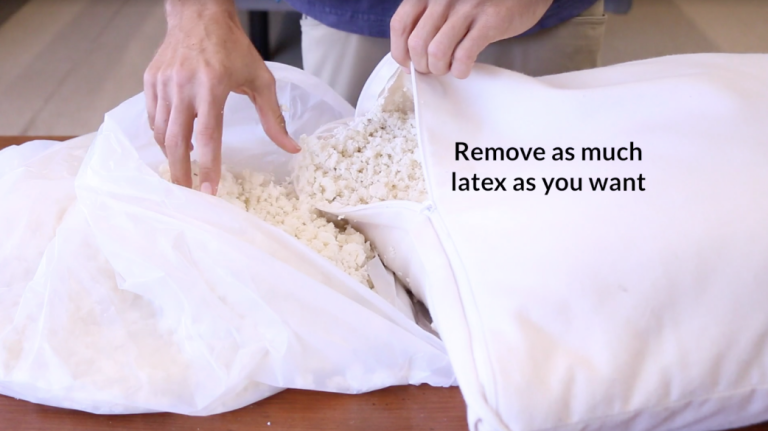
In a modular latex mattress with a zippered cover and unglued layers, each layer functions independently. When the top comfort layer eventually wears out after 8-12 years, you replace that single layer for a fraction of the cost of a new mattress. The firmer support layers underneath, which have been bearing less direct pressure, continue performing perfectly.
Compare this to a memory foam mattress: when the foam breaks down, you replace the entire mattress. With a traditional innerspring, when the coils fatigue, the whole unit goes to the landfill. A modular latex mattress lets you replace only what needs replacing, which saves money and dramatically extends the total useful life of the mattress system.
Our Natural Latex Mattress is built on this modular principle. The Sapling (9″, 2 layers), Sprout (10″, 3 layers), and Tree (13″, 4 layers) all feature fully removable organic covers and unglued layers that can be individually replaced.
Even with proper care, your mattress will eventually show signs of wear. Here is what to watch for:
If you notice these signs in a modular mattress, try rearranging layers first. If the top comfort layer is the culprit, replacing just that layer restores the mattress to like-new condition.
When evaluating mattress value, the upfront price tells only part of the story. Cost per year of use reveals the true value:
| Mattress Type | Typical Price | Lifespan | Cost Per Year |
|---|---|---|---|
| Innerspring | $500-$1,200 | 5-8 years | $100-$150 |
| Memory Foam | $800-$2,000 | 7-10 years | $114-$200 |
| Natural Latex | $1,500-$3,000 | 15-25 years | $60-$200 |
A natural latex mattress often has the lowest cost per year of any mattress type despite having a higher upfront price. Factor in the ability to replace individual layers instead of the whole mattress, and the long-term economics become even more favorable.
A 100% natural latex mattress lasts 15-25 years. A memory foam mattress typically lasts 7-10 years. Natural latex outlasts memory foam by roughly two to one due to its superior elasticity and resistance to permanent compression.
Dunlop latex lasts longer. Its denser structure is more resistant to compression and wear over time. Talalay is lighter and softer, which makes it excellent for comfort layers but less durable than Dunlop for long-term support.
Yes. Rotate the mattress head-to-foot every 3 months. Flip and rotate individual layers every 3-6 months. Use a proper foundation with slats no more than 3 inches apart. Avoid direct sunlight exposure, and use a mattress protector to guard against spills and moisture.
Replace individual comfort layers when they show permanent body impressions or noticeable softening. The full mattress (all layers) typically does not need replacement for 15-25 years. If only the top layer has worn down, replace that layer alone, the support layers likely have many more years of life.
Yes. Softer latex layers (lower ILD) compress more under body weight and break down faster than firmer layers. A soft Talalay comfort layer may last 8-12 years, while an X-Firm Dunlop base layer can last 25-30+ years.
When measured by cost per year of use, a natural latex mattress is often the most economical choice. A $2,000 latex mattress lasting 20 years costs $100 per year. A $1,000 memory foam mattress lasting 8 years costs $125 per year. Combined with the ability to replace individual layers, latex delivers the best long-term value.