Have a saved cart?
Enter your email to restore it.

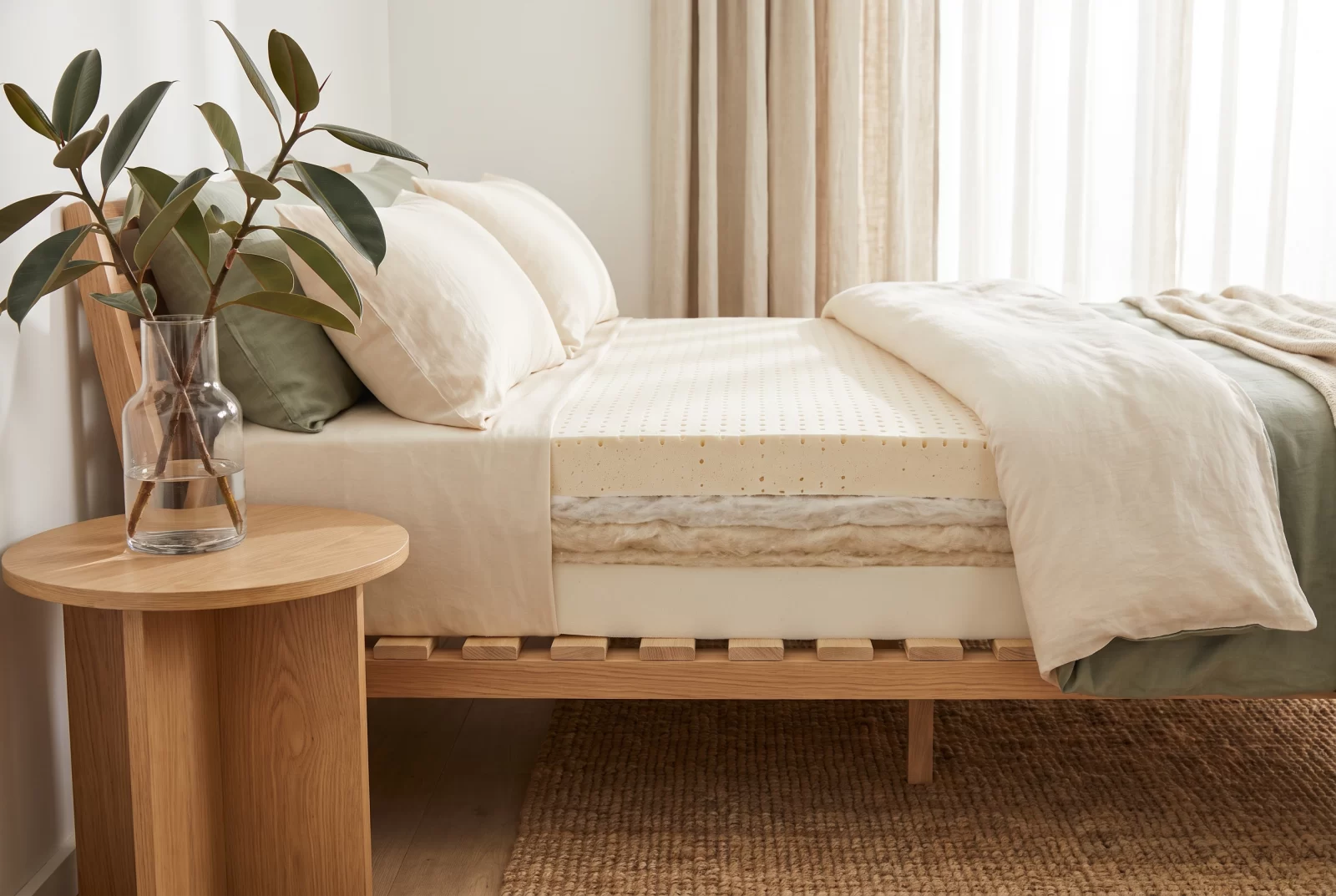
Shopping for a latex mattress can feel like reading a foreign language. Dunlop, Talalay, GOLS, blended, synthetic, natural: the terms pile up quickly, and the marketing rarely clarifies what any of it means for the bed you’ll sleep on. Underneath the jargon, the definition is simple. Natural latex is a foam made from the sap of the rubber tree, with no petroleum-based ingredients.
The confusion isn’t accidental. Much of the latex on the market is synthetic or blended rather than 100% natural, and manufacturers often blur those lines to keep costs down. Understanding what natural latex is, and what it isn’t, is the difference between buying a mattress that lasts two decades and one that sags in six years.
This guide walks through what natural latex is, how it’s manufactured, how the two main production processes compare, what certifications verify, and how latex holds up against other mattress materials.
Natural latex is a foam made from the milky sap of the Hevea brasiliensis tree, commonly called the rubber tree. Tappers score the bark, collect the liquid sap, and process it into a resilient, breathable foam that can be used as either a mattress core or a comfort layer.
That’s the entire raw material story. There’s no petroleum, no synthetic polymer base, no proprietary chemistry. Natural latex is a plant-derived product, and rubber trees themselves are renewable. They absorb CO2 during their productive lifespan and the finished foam is biodegradable at end of life.
The complication is that “latex” on a product label can mean several very different things:
All three can legally be labeled “latex.” Only the first is what most people mean when they picture a natural or organic mattress. Blended and synthetic latex also have significantly shorter lifespans, typically 6 to 12 years, compared to 15 to 20+ years for 100% natural latex.
One of the most persistent misconceptions is that Dunlop and Talalay are different materials. They aren’t. Both begin as the same liquid sap from the same rubber tree. The difference is entirely in how that sap is processed into foam.
Dunlop is the older, simpler method. Liquid latex is whipped into a froth, poured into a mold, and baked. During baking, heavier particles settle toward the bottom of the mold, which creates a foam that’s slightly denser at the base than at the top.
The result is a firmer, denser foam that works well as a support core. Dunlop uses fewer manufacturing steps and less energy than Talalay, which is why it’s generally considered the more eco-friendly and less expensive of the two.
Talalay, invented in the 1940s, is more elaborate. The mold is only partially filled with liquid latex, then vacuum-sealed. The vacuum causes air bubbles inside the latex to expand and distribute evenly throughout the mold. The latex is then flash-frozen to around −20°F, which locks the bubble structure in place. Carbon dioxide is pushed through the material to gel it, and finally it’s baked.
The extra steps produce a foam with a more uniform, homogeneous cell structure. Talalay tends to be lighter, softer, and bouncier, well suited to comfort layers, especially for side sleepers who need pressure relief at the hips and shoulders.
Neither is objectively better. They do different jobs:
Many high-quality mattresses combine both: a Dunlop core for structural support with a Talalay comfort layer on top. Our Natural Latex Mattress is built this way, with customizable layers so each side of a bed can be configured to a different sleeper’s needs.
Because “natural latex” and “organic latex” are used loosely in marketing, third-party certification is the only reliable way to verify what’s inside a mattress. For latex foam specifically, that certification is GOLS (Global Organic Latex Standard).
GOLS is administered by Control Union and applies to the latex foam itself, not the wool cover, not the cotton casing, not the whole mattress. Each organic component in a finished mattress requires its own separate certification.
To be GOLS certified, a latex product must:
GOLS also enforces social and labor standards at certified facilities: safe working conditions, fair living wages, no child labor, and no discrimination. So the certification covers both the material composition and the ethics of how it’s made.
One practical note: GOLS certification is currently available for Dunlop latex. Talalay latex is often certified through other standards like eco-INSTITUT or OEKO-TEX, which verify low emissions and absence of harmful substances but aren’t organic certifications in the same sense as GOLS.
Latex sits in a distinct category from both memory foam and innerspring, with a different feel and a very different performance profile.
This is where natural latex clearly outperforms. A high-quality natural latex mattress typically lasts 15 to 20 years, and firm Dunlop layers can approach 25. By comparison, memory foam mattresses typically last 5 to 7 years and traditional innersprings around 5. High-quality latex resists indentations and body impressions over time, one of the main reasons it earns above-average durability ratings.
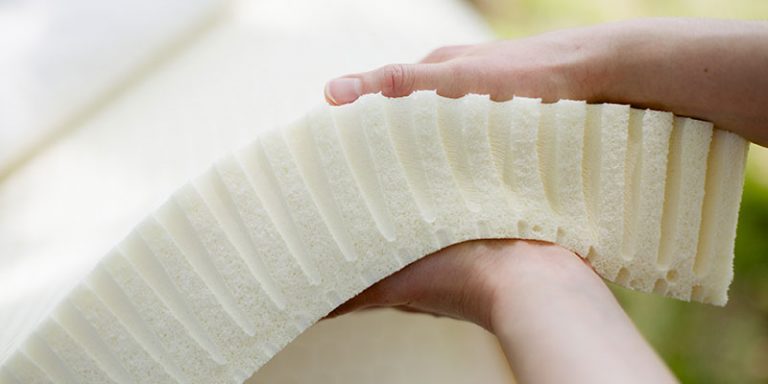
Natural latex has an open-cell structure and is often manufactured with pincore ventilation: small perforations that run through the foam to enhance airflow. This makes it one of the cooler-sleeping mattress materials available, and cooler than nearly any synthetic foam. Latex is responsive rather than sinking, so sleepers rest on top of the surface rather than being enveloped in a heat-trapping pocket the way dense memory foam tends to do.
100% natural latex mattresses have minimal to no VOC off-gassing because they contain no petroleum-based foams and no synthetic adhesives. Any faint rubber scent typically dissipates within a few days to two weeks. That’s a noticeable difference from memory foam, which often carries a chemical smell for weeks after unboxing.
Natural latex is naturally resistant to dust mites, mold, and mildew: three common allergens and asthma triggers. This makes it a practical choice for allergy-prone sleepers, though people with a specific latex allergy should consult their doctor before purchasing.
Organic and natural latex mattresses generally use wool as a fire barrier. Wool is inherently flame-resistant and meets federal flammability standards without the use of chemical flame retardants, another reason latex mattresses tend to appeal to buyers focused on reducing chemical exposure at home.
Natural latex isn’t the right fit for every buyer, and the honest downsides are worth discussing before purchase.
Cost. Latex mattresses are more expensive than most other types. Queen sizes commonly range from $1,300 to $3,000. The reason is straightforward: harvesting sap from rubber trees is labor-intensive, and the manufacturing process, particularly Talalay, is energy-intensive. You’re paying for material and process, not marketing markup.
Weight. Latex is dense and significantly heavier than memory foam or innerspring mattresses. This means you can’t put a latex mattress on a traditional box spring, which was designed to flex. You need either a platform bed with slats spaced roughly 2 to 3 inches apart or a solid slatted foundation. Our Mattress Foundation is built specifically for this: closely spaced slats that give latex the flat, firm base it needs to perform as designed.
Feel isn’t for everyone. Latex is responsive and buoyant. It doesn’t have the deep sink of memory foam. Sleepers who specifically want that hugged, sinking-in sensation may find latex feels too firm or too bouncy, even in softer Talalay configurations.
A natural latex mattress is the anchor, but the material works best when paired with compatible bedding and accessories. A Shredded Latex Pillow extends the same responsive, breathable feel to head and neck support, and the loft is adjustable: you add or remove fill to match your sleep position. A Natural Latex Topper is a way to fine-tune firmness on an existing mattress or refresh a latex bed several years into its life.
For a fuller picture of how we source, layer, and assemble our latex mattresses, see Our Process.