Have a saved cart?
Enter your email to restore it.

The Complete Guide
Everything I’ve learned in nearly two decades of building organic mattresses, distilled into one place. No fluff, no affiliate-link bait. Just what you actually need to know.
15-25
years of durability, 3x longer than memory foam
100%
natural materials, zero petrochemicals, zero off-gassing
18
years building organic mattresses, customer by customer
4.8
star rating from 700+ verified customer reviews
Read this first
You’ve stopped believing the foam-mattress marketing. Latex isn’t just another option in a sea of compressed-in-a-box memory foam. It’s a fundamentally different material with a fundamentally different lifespan, feel, and chemistry.
This guide is everything I’ve learned in nearly two decades of building organic mattresses. No affiliate links, no “best 10 mattresses of 2026” lists. Just what you actually need to know before you spend $1,500+ on something you’ll sleep on for the next 20 years.
If you’d rather skip ahead and configure your own, build your mattress here. Every layer is customizable, free shipping, 365-day comfort program.
1. The Material
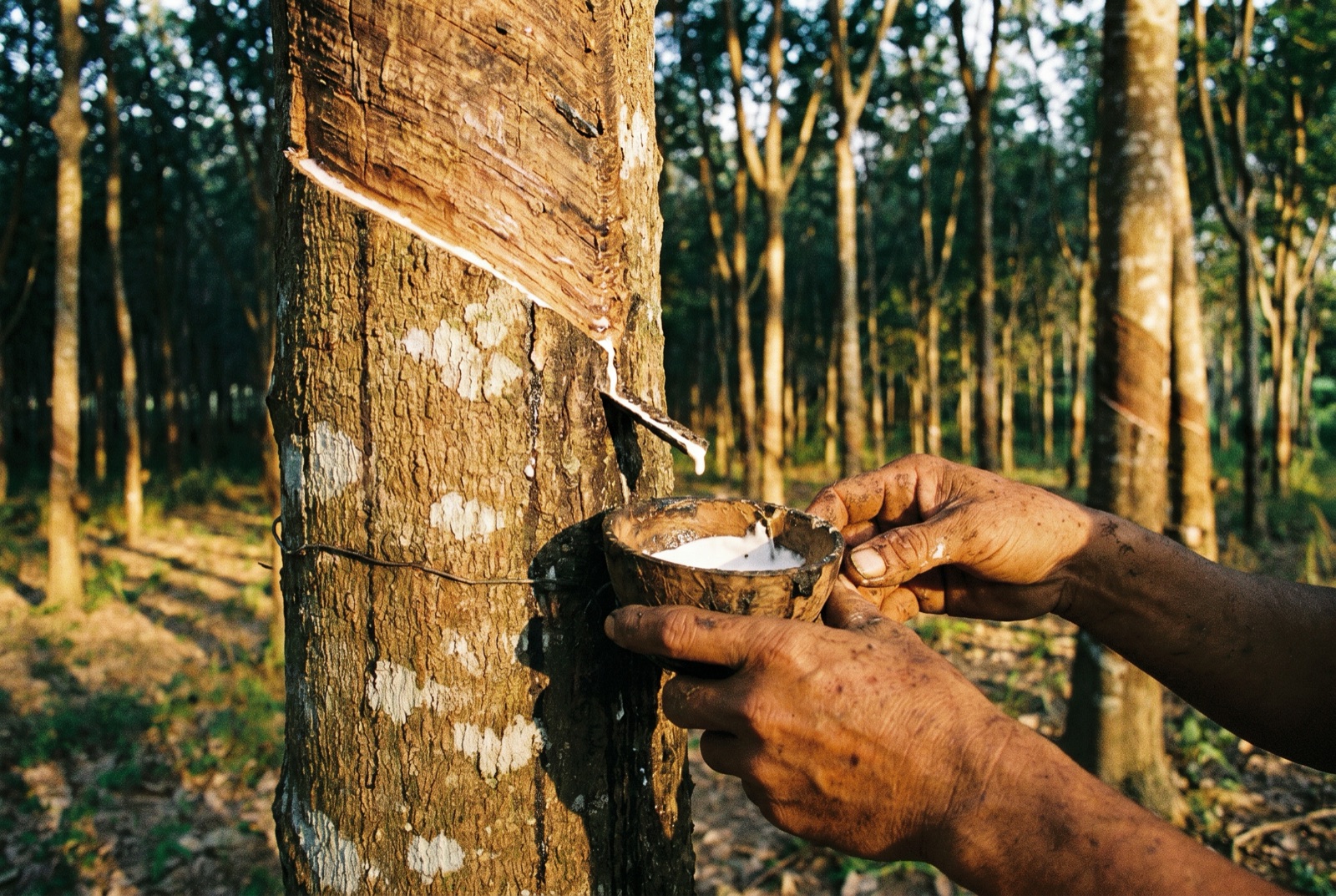
Latex starts as the milky white sap that drips out of the Hevea brasiliensis tree, the rubber tree, native to the Amazon and now grown sustainably across Southeast Asia. Tappers cut a shallow groove in the bark, and the latex flows out like maple sap. The trees aren’t harmed, and they keep producing for 25 to 30 years.
That liquid latex gets foamed, molded, and baked into the springy, dense slabs that go into a mattress. Done correctly, the result is a single-piece, open-cell foam that feels nothing like the petroleum-based foams most mattresses use. Done incorrectly, and most “latex” mattresses on the market are done incorrectly, the rubber tree sap gets blended with synthetic styrene-butadiene rubber and labeled “natural latex.”
There are three categories of “latex”:
If a mattress brand can’t tell you what percentage of their latex is natural, it’s not 100%. If they say “natural latex” but won’t show you a third-party certification (GOLS or eco-INSTITUT), it’s almost certainly blended. The only way to be sure is to ask for the certificate, with the producer name and date.
We use only 100% natural Talalay (eco-INSTITUT certified) and 100% natural or GOLS-organic Dunlop. Every layer comes with documentation.
2. Dunlop vs Talalay
There are two manufacturing processes for natural latex. They produce noticeably different feels, and the right choice depends on what you’re using the latex for.
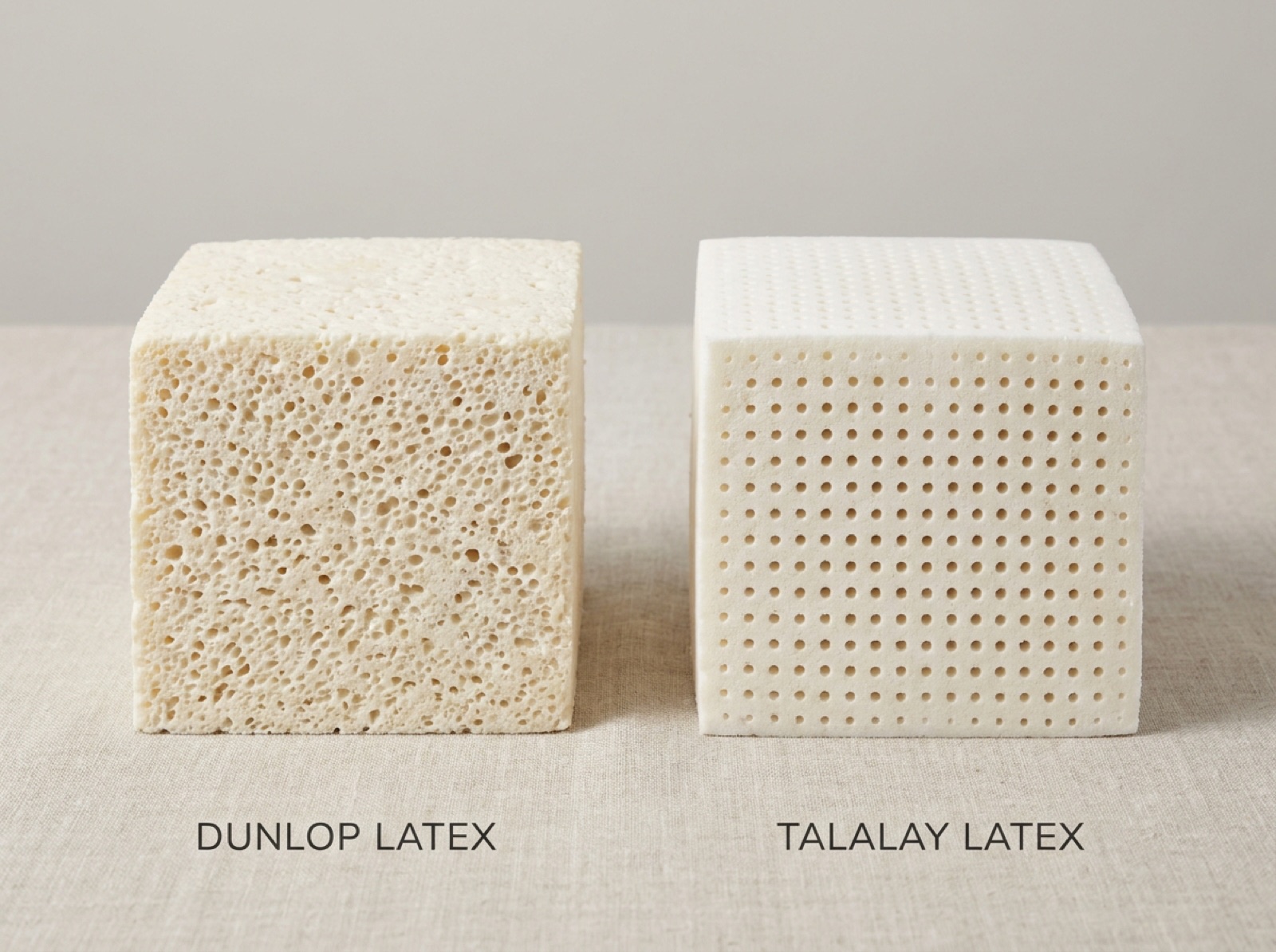
Dunlop is the older, simpler process. Liquid latex is whipped, poured into a mold, and baked. The result: dense, supportive, slightly firmer feeling at any given ILD. Best as a support layer, for heavier sleepers, and for back or stomach sleepers.
Talalay is a five-step process: whip, pour, vacuum-evacuate, flash-freeze, then bake. The vacuum step creates uniform open cells throughout. The result: airy, buoyant, “pillowy.” Best as a comfort layer, for side sleepers, and for anyone who finds Dunlop slightly too firm.
| Dunlop | Talalay | |
|---|---|---|
| Process | Foam, mold, bake | Foam, mold, vacuum, freeze, bake |
| Density | Slight gradient | Uniform throughout |
| Feel | Dense, supportive, “grounded” | Airy, buoyant, “pillowy” |
| Best as | Support layer | Comfort layer |
| Cooling | ✓ Excellent | ✓ Even better |
| Durability | 15-25 years | 10-20 years |
You probably want both. Our most popular configuration, the Leaf 10-inch three-layer build, uses Dunlop on the bottom for support, medium Dunlop in the middle, and a Talalay comfort layer on top. That gives you the “grounded but cushioned” feel that 70% of our customers prefer.
You don’t have to decide upfront. The whole mattress is configurable, and if you order one and decide you want more Talalay (or more Dunlop), we ship you a replacement layer at our discounted comfort-program rate. No need to ship the whole bed back.
3. ILD Firmness
Every latex layer has an ILD, Indentation Load Deflection, measured in pounds. ILD is how many pounds of pressure it takes to compress a 4-inch-thick sample by 25%. Higher number, firmer foam.
Sleeping Organic’s current latex choices run from X-Soft Talalay 14–19 through X-Firm 44. Here’s the practical scale:
| ILD | Firmness | Feels like |
|---|---|---|
| 14–19 | X-Soft Talalay | Cloud-like, deep contour for a top comfort layer or Talalay topper |
| 19–22 | Soft | Plush, gentle pressure relief |
| 30–32 | Medium | Balanced, push and pushback |
| 37–40 | Firm | Substantial support, minor sink |
| 44 | X-Firm | Maximum support, “floor with a blanket” |
The trick is that ILD only tells you how firm a layer is, not how firm the mattress feels. The mattress feel is determined by:
That’s why “Medium” doesn’t mean the same thing across brands, and why review sites that just say “this mattress feels medium-to-firm” are useless. Without your weight, position, and the specific layer config, “medium” tells you nothing.
Go slightly softer than you think you need. Every customer who returns a layer for replacement chose too firm, almost never too soft. You can always rearrange a multi-layer build to put the firmest layer on top. You can’t make a firm layer softer.
Our 365-day comfort program covers exactly this scenario. If your initial pick doesn’t feel right, you can swap one layer for a different ILD at our discounted rate.
4. The Comparison
Most “best mattress” lists are written by affiliates who get paid the same commission whether you buy a $400 foam-in-a-box or a $4,000 hand-built bed. They have no incentive to be honest about durability, materials, or who each mattress is actually for.
Here’s the unvarnished comparison.
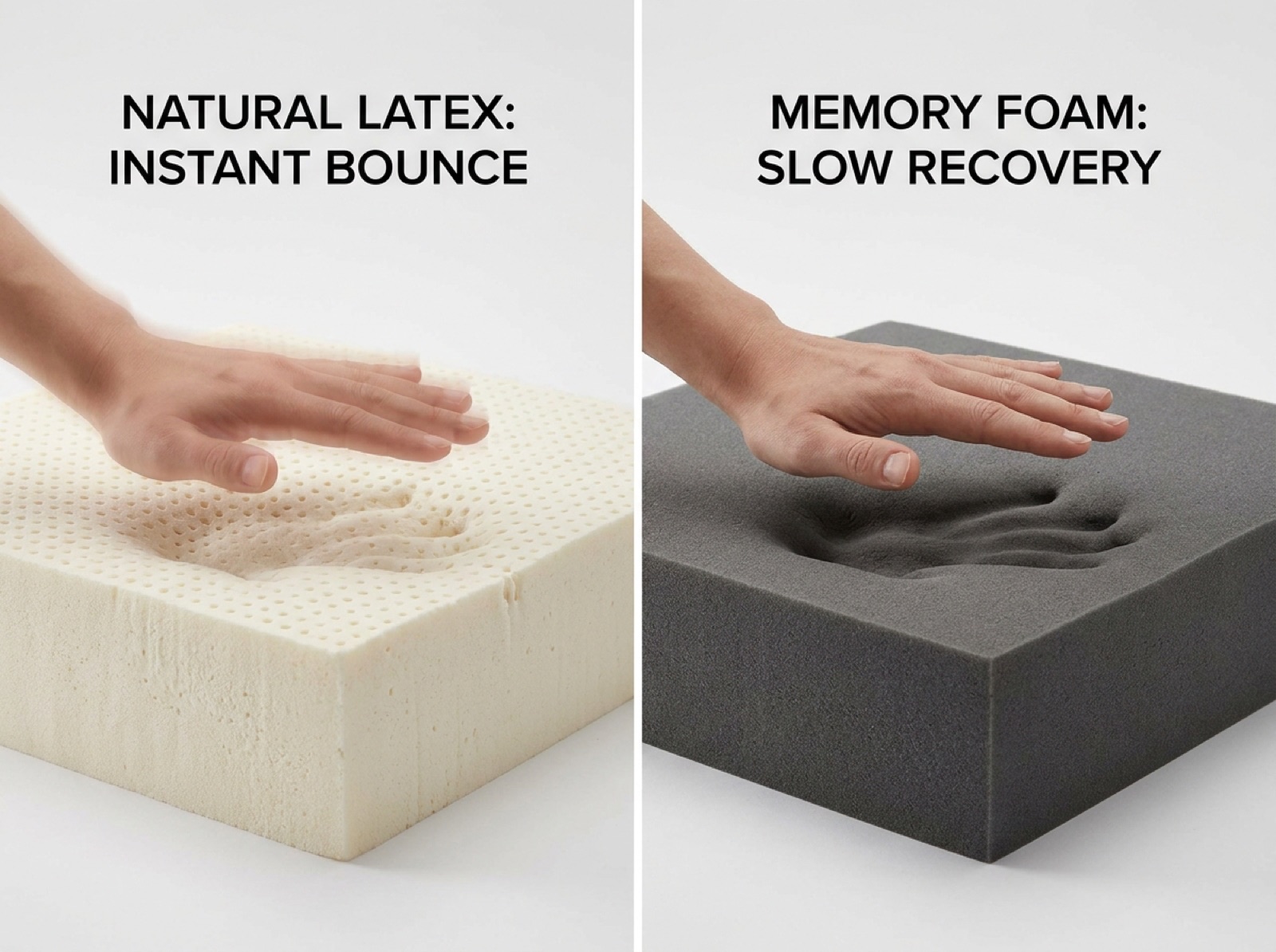
Memory foam is polyurethane plus chemical gels and additives that give it the “slow sink” quality. It was originally developed by NASA to cushion astronauts during launch. It’s good at one thing: distributing pressure through deep contour. It’s bad at almost everything else.
| Feature | Natural Latex | Memory Foam |
|---|---|---|
| Material | ✓ Rubber tree sap | ✗ Petroleum-based polyurethane |
| Response | ✓ Instant, springs back | ✗ Slow, holds the impression |
| Temperature | ✓ Cool, open-cell airflow | ✗ Hot, traps body heat |
| Off-gassing | ✓ Minimal, plant-based | ✗ VOCs for weeks to months |
| Lifespan | ✓ 15-25 years | ✗ 3-7 years |
| Repair | ✓ Layer-replaceable | ✗ Replace whole mattress |
Memory foam isn’t a scam. It’s a real material with a real use case. If you want maximum pressure relief at the lowest cost and you don’t mind sleeping hot, it works. But the trade-off is durability. Memory foam compresses permanently. The same six inches of foam that felt great year one becomes a body-shaped trough by year four. There’s no way to fix it. You just buy another mattress.
Latex is the inverse trade-off. Higher upfront cost, longer lifespan, cooler sleep, more responsive feel. Over the 20-year life of a latex mattress, you’d buy 4 to 6 memory-foam beds.
A “hybrid” mattress is innerspring coils plus a foam comfort layer on top. The marketing pitch: best of both worlds. The reality: it depends entirely on what’s in the comfort layer.
A latex-over-coils hybrid (some manufacturers actually make these) can be excellent. We don’t make a hybrid because our customers tell us they prefer the consistent feel of an all-latex stack, but if a hybrid is what you want, look for one with at least 3″ of 100% natural latex on top, not “natural-blend” foam.
A memory-foam-over-coils hybrid is just memory foam with extra steps. The coils don’t fix the heat, the off-gassing, or the durability problem.
Traditional innerspring mattresses are coils with thin foam padding. They’re cheap, they sleep cool, and they don’t last. The padding compresses in 2 to 4 years and you start feeling the coils. Pillow-top innersprings buy you a few more years but the same fundamental problem applies.
Innerspring is the right choice for a guest-room mattress under $500 that you’ll replace in five years. It’s the wrong choice if you want to actually invest in your sleep.
I’ll be the first to say it. Latex isn’t for everyone:
For everyone else, the math is overwhelming. Latex costs more upfront and saves you money for the next 20 years.
5. Certifications
Every organic-mattress brand throws a wall of certification logos at you. Most shoppers can’t tell which ones mean something and which ones are paid badges. Here’s the actual hierarchy.
These cost real money to obtain, require ongoing audits, and verify what’s actually in the product. If a brand has these, you can trust them.
The certification documents are available on request. Email [email protected] and we’ll send the current PDFs.
6. Off-Gassing
The smell of a new mattress straight out of the box is one of the clearest signals of what’s actually inside it. If you can smell chemicals, there are chemicals.
Polyurethane is made from polyols and isocyanates plus dozens of catalysts, fire retardants, and stability additives. As the foam cures, residual chemicals continue to off-gas for weeks to months. Some are well-studied carcinogens.
Natural latex has a mild, slightly sweet rubbery smell, similar to a new yoga mat. The smell dissipates within 1 to 3 days of unwrapping.
Federal law requires every mattress sold in the US to pass an open-flame burn test. The cheapest way to pass is to spray chemical fire retardants onto the foam. PBDEs, brominated compounds, things you don’t want sleeping next to your face.
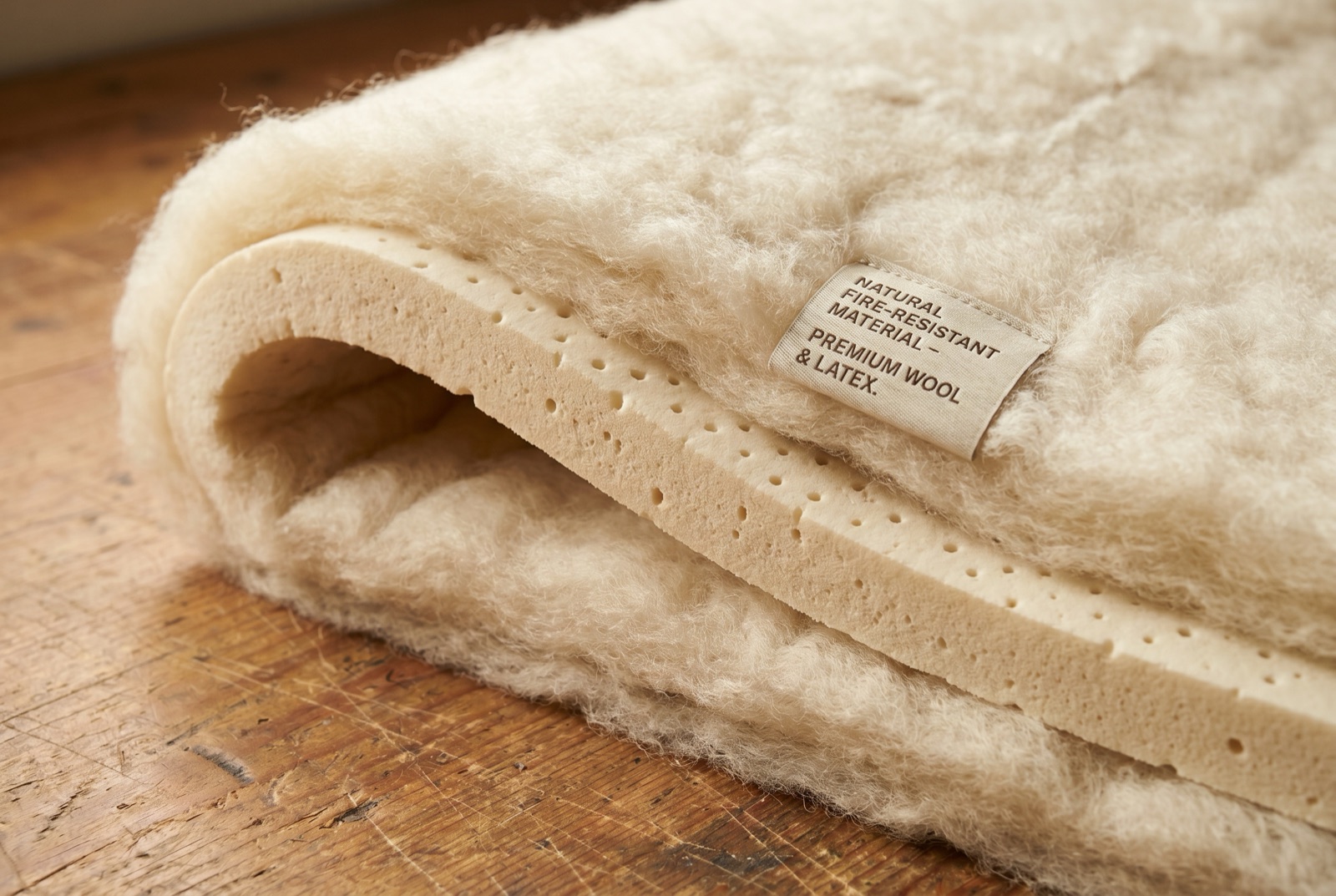
The non-toxic alternative is wool. A 1-inch layer of natural wool wrapped around the latex core passes the federal burn test without any chemical treatment. Wool is naturally flame-resistant because of its high keratin content.
Every mattress we make is wrapped in our wool/cotton cover. No chemical fire retardants. No exceptions. This is part of why a real organic mattress costs more than a foam-in-a-box. Wool-wrapping is more labor and more material than spraying retardant.
By day three, you should smell nothing. If you still detect a strong chemical smell after a week, contact us. Something is wrong.
7. Allergies
Latex allergies are real, but they’re widely misunderstood. The conversation usually conflates three different things:
The proteins responsible for Type I allergic reactions are water-soluble. High-quality natural latex manufacturing includes a multi-stage water washing step that removes nearly all of them. The latex used in our mattresses goes through this process.
That doesn’t mean it’s allergen-free. It means the protein concentration is reduced by 95%+ compared to raw latex. For most people with mild latex sensitivities, the residual concentration is below their reaction threshold.
If you have a confirmed Type I latex allergy with anaphylactic history, do not buy a latex mattress without consulting your allergist, even if it’s protein-washed. Anaphylaxis is dose-dependent for some people but not others.
If you’ve had any anaphylactic reaction to bananas, avocados, kiwi, latex condoms, medical gloves, or balloons, talk to an allergist before buying. The cross-reactivity is real.
If you’ve had mild itching from a latex glove, a skin rash from a balloon, or “I think I’m sensitive but I’ve never been tested”, you’re almost certainly fine on a protein-washed latex mattress. The double-layer barrier (mattress cover + sheets) means you never touch the latex directly. Plus, if you order from us and have any reaction, the 365-day comfort program covers full return.
8. Temperature
The single most common complaint about memory foam: it sleeps hot. This isn’t a perception issue, it’s a structural one. Memory foam is a closed-cell foam, meaning the air pockets inside are sealed. Heat that enters the foam doesn’t move. Your body temperature builds up under you and you wake up sweating.
Latex is structurally different. The foaming process creates an open-cell structure, microscopic interconnected air channels throughout the foam. Heat dissipates through the channels instead of pooling. Talalay takes this further with its vacuum-evacuation step.
| Material | Sleep temperature |
|---|---|
| Memory foam (standard) | ✗ Significantly hotter than ambient |
| Memory foam (gel-infused) | ✗ Slightly hotter than ambient |
| Hybrid (memory foam over coils) | ✗ Slightly hotter than ambient |
| Innerspring | Roughly ambient |
| Latex (Dunlop) | ✓ Cool, slightly below ambient |
| Latex (Talalay) | ✓ Coolest of all foams |
Gel-infused memory foam markets itself as the cooling solution. The gel does conduct heat away from your body initially, but the gel saturates within 20 to 30 minutes. Once saturated, you’re back to sleeping on standard memory foam. Real cooling requires open-cell airflow, not a saturated gel layer.
The Real Cost of Sleep
Over 20 years, a natural latex mattress costs less per night than a memory foam mattress you replace every 5 years.
$0.26
per night
$1,898 ÷ 20 years
Natural Latex
$0.44
per night
$800 x 3 replacements ÷ 15 years
Memory Foam
9. Lifespan
Latex is the longest-lived mattress material in mainstream use. Our oldest customer-owned beds are 22 years old and still in service. The reason isn’t magic. It’s chemistry.
Latex is essentially solidified rubber tree sap, the same molecular structure as the rubber in industrial belts and tires. The molecules are cross-linked, meaning compression doesn’t permanently deform them. Memory foam doesn’t have this. The polymer chains slip past each other under repeated load and don’t return to original shape.
Latex compression returns to baseline every time you get out of bed. After 20 years, you’ll see no body impressions, no edge sag, no soft spots.
The bottom Dunlop layer essentially never fails in normal home use. We’ve serviced beds where the customer replaced two top layers and a cover and the bottom layer is still going strong at 20 years.
10. Cover Materials
The cover wraps the latex core and is what your sheets rest against. Most shoppers focus entirely on the foam and ignore the cover. That’s a mistake. The cover affects breathability, fire safety, durability, and how the mattress feels against your body.
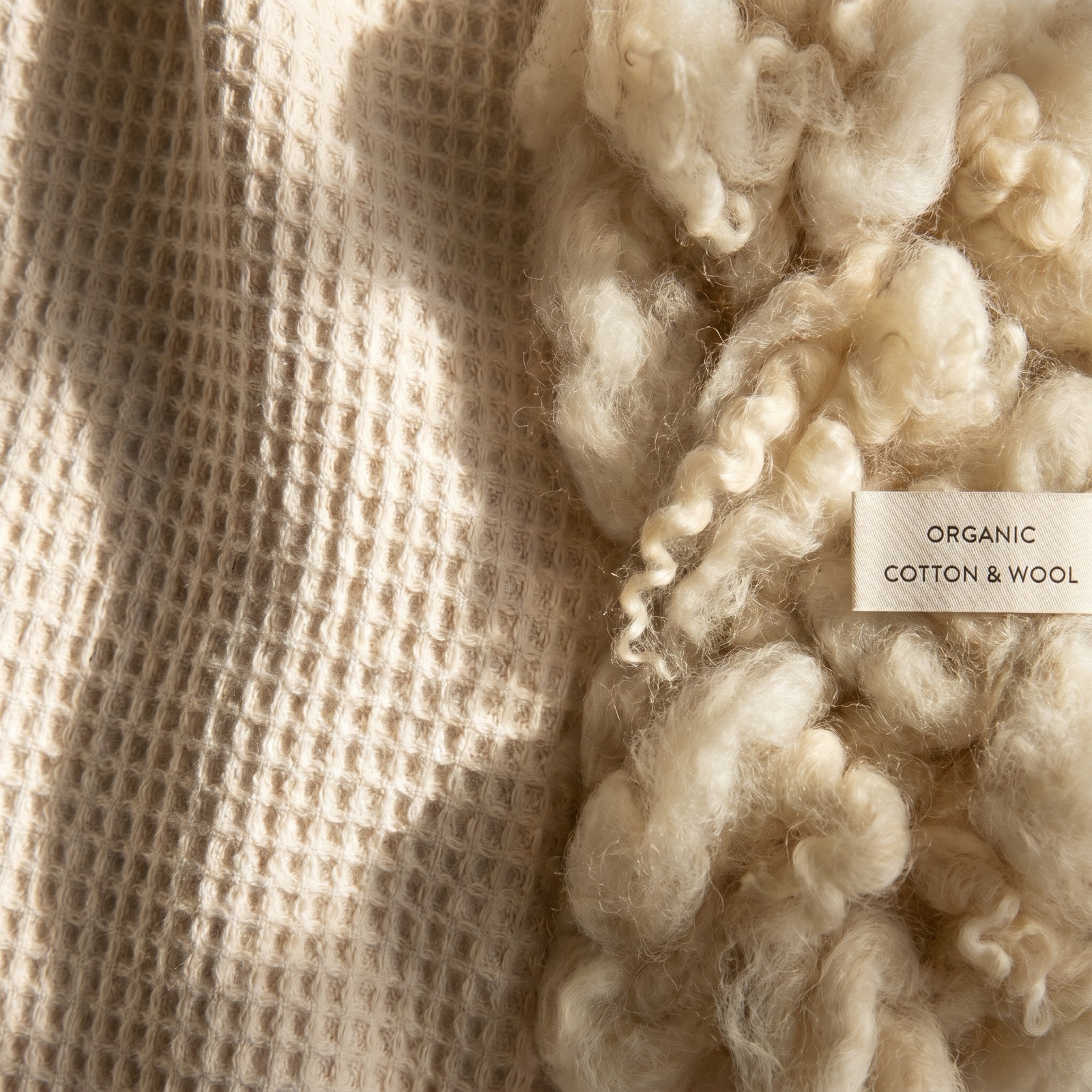
The standard high-end mattress cover is organic cotton outer with a wool inner layer. Cotton is breathable, soft, and washes well. Wool is naturally flame-resistant, wicks moisture, and adds insulation in winter while staying cool in summer.
We use this exact construction on every Sleeping Organic mattress. The cover is removable via a perimeter zipper for spot cleaning or eventual replacement.
Most customers tell us they bought a Sleeping Organic mattress for the latex and ended up loving the wool. Wool does several things at once:
Synthetic mattress fillers can’t do any of these things. Wool is one of the things that makes a real organic mattress feel different the moment you lie on it.
11. Foundations
A latex mattress is heavy and dense. It needs a different kind of support than a memory foam or innerspring mattress. Get the foundation wrong and your warranty is voided, plus the mattress will sag prematurely.
Standard sleeping height is 25 to 27 inches from floor to top of mattress. With our 10″ mattress, that means a foundation between 5.5″ and 8″ tall. Choose based on your bed frame: a 10″ frame needs a 5.5″ low-profile foundation, not 8″.
12. Care
Proper care extends a latex mattress from “great for 15 years” to “great for 25 years.” None of it is hard.
Latex itself is waterproof. Mattress covers are not. If you spill liquid: blot immediately (don’t rub), unzip and remove the cover, spot-clean with cold water and mild soap, air dry. The latex core can be wiped with a damp cloth.
For larger accidents (kid sickness, pet incidents): the cover is fully removable and can be hand-washed in the bathtub. Air dry over a railing, never put it in a dryer (heat damages the wool inner layer).
If a single layer feels worn but the others are fine, just replace that layer. Our comfort program has this exact use case in mind. Cost is roughly ⅓ of a new mattress and the bed feels new again.
13. How to Buy
Three distinct shopping models exist for latex mattresses. Each has trade-offs.
Pros: Try before you buy. Salesperson can walk you through options.
Cons: Selection is dictated by what the showroom carries. Usually 2 to 4 latex SKUs at most, often blended. Markups are 200 to 400% over wholesale.
If you go the showroom route, demand to see the certification documents for any “natural latex” mattress before you buy. Most showroom staff can’t produce them.
Pros: Wider selection than any showroom. Real warranties. Trial periods.
Cons: Most “online latex” mattresses are blended, even from premium brands. Few offer full layer customization. Returns require shipping the bed back.
Pros: Get exactly the bed you want. Layer-by-layer comfort program. Lowest blend risk.
Cons: More upfront decision-making. Builds take 1 to 3 weeks to manufacture before shipping.
This is what we do, and I think it’s the right model for serious mattress buyers. You’re spending 20 years’ worth of sleep on this thing.
14. Myths
Most are repeated by other “honest mattress review” sites that aren’t actually honest, just well-SEOed.
Myth: All latex is the same.
False. Composition (100% natural vs blended), process (Dunlop vs Talalay), and origin (organic vs conventional) all materially change the mattress.
Myth: Latex mattresses are too firm.
False. Our current options run from X-Soft Talalay 14–19 through X-Firm 44. The plushest beds we make are softer than the average pillow-top innerspring.
Myth: Latex makes you sleep hot.
False. The opposite. Latex sleeps cooler than memory foam, hybrid, and most innerspring mattresses.
Myth: Latex is only for people with allergies.
False. The clean-materials angle is appealing for allergy sufferers, but the larger reasons people buy latex are durability, cooling, and feel.
Myth: A more expensive mattress is automatically better.
False, with caveats. Above $5,000 you’re paying for branding. Below $1,000 you’re paying for synthetic materials with short lifespans. The sweet spot for genuine quality is $1,500 to $3,500 for a queen.
Myth: Box-in-a-box mattresses are just as good as full-build.
False. Compression in a box damages latex over time. Brands that ship latex in compressed form usually use thinner, lower-density latex that compresses safely.
Myth: GOLS organic latex is identical to 100% natural non-organic latex.
Mostly false. Both are 100% rubber tree sap. The difference is supply chain. GOLS certifies sustainable tapping, fair labor, no synthetic processing aids. The latex is essentially identical at the molecular level. The certification covers the process, not the material outcome.
15. Decision
By now you have most of the information you need. Here’s how to actually make the call.
If unsure, go softer. You can always rearrange or replace layers later.
For most people, the all-purpose answer is: Talalay top, Dunlop middle and bottom. Contour where it matters (shoulders, hips), support where it matters (lower back, feet).
If you’re sleeping with a partner whose preferences differ from yours by more than one ILD step, split the bed. Same cover, two firmness profiles, no extra charge on Queen/King/Cal King.
Order, sleep on it for a month, then make adjustments. Our 365-day comfort program exists for exactly this. The first night on a new bed is rarely the bed’s “real” feel. By night 14, your body has adjusted and you know what’s working and what isn’t.
About the Author
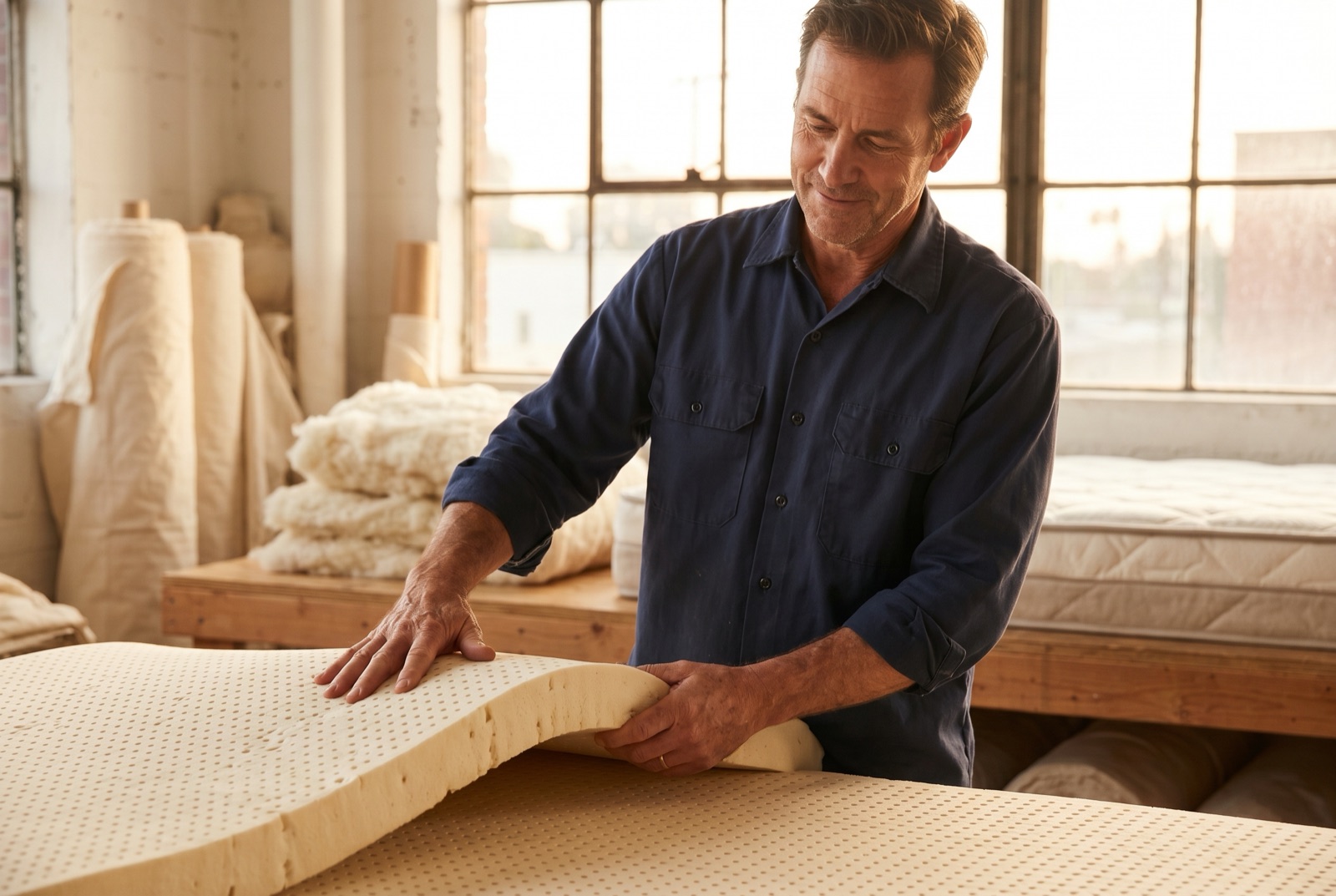
I’ve spent 18 years building organic mattresses by hand, customer by customer. Every page on this site, including this one, reflects what we’ve learned working directly with thousands of sleepers across all 50 states.
If you have questions a guide can’t answer, call us at (800) 625-4042 or open a ticket. We’d rather spend 20 minutes on the phone helping you pick the right bed than have you guess and return it.
Build Yours
Free shipping. Free pillows. 365-day comfort program. Built to spec in our facility, hand-shipped layer-by-layer, no compression damage.
Configure Your Latex Mattress