Have a saved cart?
Enter your email to restore it.

A 100% natural latex mattress does not off-gas. Zero volatile organic compounds. Zero chemical emissions. The material is made from the sap of rubber trees, vulcanized with heat, and contains no petroleum-based chemicals that could volatilize into your bedroom air.

But many mattresses sold as “latex” are not 100% natural. Synthetic latex, blended latex, and the adhesives used between layers can all off-gas significantly. The answer to whether a latex mattress off-gasses depends entirely on what’s actually in it.
Off-gassing is the release of volatile organic compounds (VOCs) from a solid material into the surrounding air. These compounds evaporate at room temperature and become airborne gases that you inhale. Common mattress-related VOCs include formaldehyde, benzene, toluene, and various flame retardant chemicals.
You know the “new mattress smell” that comes with a conventional bed? That’s off-gassing. Those chemical fumes are strongest when the mattress is new and gradually decrease over weeks to months, though low-level emissions can continue for years.
Off-gassing from mattresses is a legitimate health concern because you spend 6-9 hours per night breathing inches from the mattress surface. Chronic low-level VOC exposure has been linked to headaches, respiratory irritation, allergic reactions, and in some cases more serious health effects.
Natural latex is harvested as liquid sap from Hevea brasiliensis (rubber) trees. It’s poured into molds and vulcanized using heat and a small amount of sulfur. The finished product is a natural polymer with no added petroleum chemicals, no synthetic foaming agents, and no chemical flame retardants.
Because there are no volatile synthetic compounds in the material, there’s nothing to off-gas. A 100% natural latex mattress emits no measurable VOCs. Period.
This makes natural latex fundamentally different from every petroleum-based foam on the market, including memory foam, polyurethane foam, and synthetic latex. The comparison between latex and memory foam is particularly stark when it comes to chemical emissions.

Synthetic latex (styrene-butadiene rubber, or SBR) is a petroleum-derived product manufactured through chemical synthesis. It off-gasses the same way other petroleum-based foams do. The chemical compounds used to create synthetic latex are volatile, and they release into the air after the mattress is unwrapped.
Blended latex is a mix of natural and synthetic. The ratio varies wildly. Some blended latex is 70% natural and 30% synthetic. Some is the reverse. The more synthetic content, the more off-gassing. But even a small percentage of synthetic material introduces VOCs that wouldn’t be present in 100% natural latex.
The problem is labeling. A mattress described as a “latex mattress” or even a “natural latex mattress” might contain blended material. Checking for organic mattress certifications like GOLS is the only reliable way to verify you’re getting 100% natural latex.
Even in a mattress with 100% natural latex layers, the adhesive used to bond layers together can be a source of off-gassing. Many manufacturers use solvent-based adhesives that contain VOCs. When the mattress is new, these glues release chemical fumes that can be just as problematic as the foam itself.
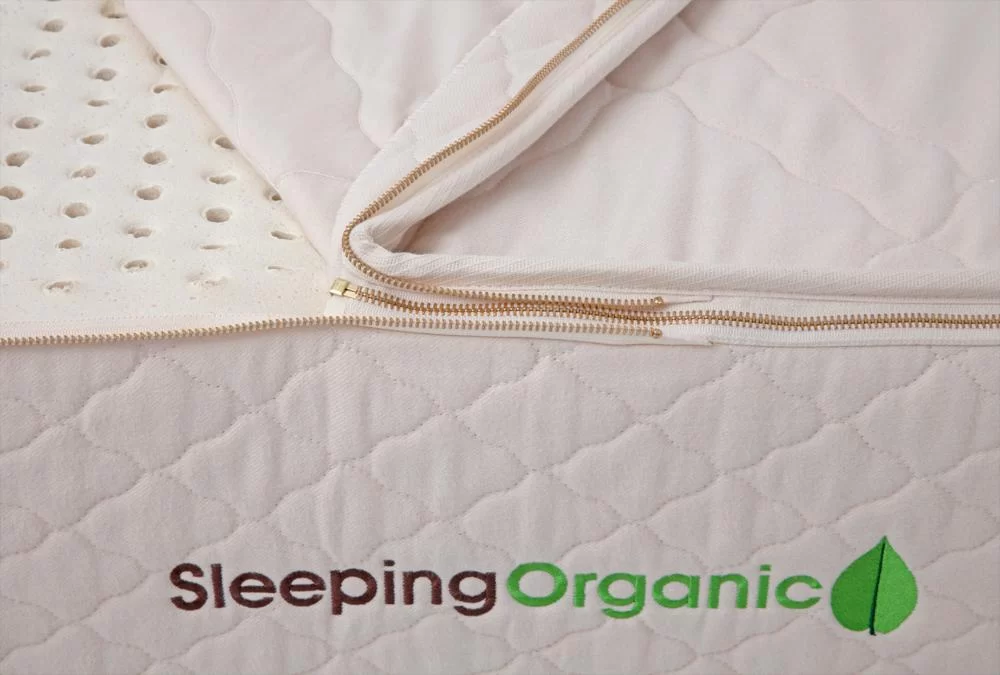
The solution is a mattress design that doesn’t use glue. When latex layers are stacked inside a zippered cover rather than bonded together, there’s no adhesive to off-gas. This is one of the advantages of a modular mattress design where individual layers sit freely inside the encasement. No glue means one less source of chemical emissions.
Brand-new natural latex has a faint rubber smell. This is not off-gassing. It’s the natural scent of vulcanized rubber, similar to what you’d smell from a new rubber band or a new pair of rubber-soled shoes. It contains no harmful VOCs.
This smell dissipates within a few days to two weeks of unpackaging, depending on ventilation. It’s not a chemical emission and poses no health risk. It’s simply the odor of a natural material, no different from the smell of new leather or fresh-cut wood.
If a latex mattress has a strong chemical or synthetic smell that persists beyond two weeks, that’s a sign the mattress contains synthetic latex, blended latex, or chemical adhesives. True natural latex smells like rubber, not like chemicals.
Memory foam (viscoelastic polyurethane foam) is made from petroleum-derived chemicals including isocyanates, polyols, and various blowing agents, catalysts, and surfactants. Every memory foam mattress off-gasses. The debate is only about how much and for how long.
Studies have detected dozens of individual VOCs emitting from memory foam mattresses, including some classified as probable carcinogens. The “new mattress” smell that memory foam owners are told to air out for 24-72 hours is the most concentrated phase of off-gassing, but measurable emissions continue for months to years at lower levels.
Natural latex exists in an entirely different category. Comparing the off-gassing profiles of natural latex and memory foam is not a spectrum. It’s a binary: one off-gasses, the other doesn’t. For a full breakdown of the differences, see our latex mattress pros and cons guide.
Three certifications directly test for chemical emissions from mattresses:
Administered by UL Environment, GREENGUARD Gold certifies that a product meets strict VOC emission limits designed to protect children and sensitive individuals. It screens for over 10,000 individual chemicals. A GREENGUARD Gold certified mattress has been independently verified to emit extremely low levels of chemical compounds.
A German testing laboratory with some of the strictest emission standards in the world. eco-INSTITUT certification means the product has been tested and found to emit VOCs well below European regulatory limits. Their testing protocols are rigorous and their thresholds are stricter than most other certifications.
OEKO-TEX tests for the presence of harmful substances in the finished product rather than measuring emissions directly. It verifies that the materials don’t contain concerning levels of formaldehyde, heavy metals, pesticides, phthalates, and other regulated chemicals.
A mattress that carries all three certifications has been verified for both material content and emissions by independent laboratories. If you have health concerns about latex mattresses, these certifications provide the most objective evidence of safety.
Verify these four things before purchasing:
If all four boxes are checked, you have a mattress with no meaningful chemical emissions.
Yes, a faint rubber smell is normal and expected. This is the natural scent of vulcanized rubber, not chemical off-gassing. It contains no harmful VOCs and dissipates within a few days to two weeks. If the smell is sharp, chemical, or persists beyond two weeks, the mattress likely contains synthetic latex or chemical adhesives.
For 100% natural latex, there is no off-gassing period because there are no VOCs to release. For synthetic or blended latex, the strongest off-gassing occurs in the first 1-4 weeks, but low-level emissions can continue for months. Memory foam typically off-gasses most intensely for 2-4 weeks with residual emissions lasting much longer.
Off-gassing from natural latex is not a concern because it doesn’t occur. Off-gassing from synthetic latex, blended latex, and memory foam can cause headaches, respiratory irritation, and allergic reactions in some people. Long-term chronic exposure to certain VOCs found in synthetic foams has been linked to more serious health effects in research studies.
Yes. Solvent-based adhesives used to bond latex layers together are a significant source of VOCs. Even a mattress with 100% natural latex can off-gas if the layers are glued with synthetic adhesive. Choosing a mattress where layers are stacked inside a zippered encasement without adhesive eliminates this issue entirely.
Both 100% natural latex and certified organic latex (GOLS) produce no meaningful off-gassing. The difference is traceability and verification. “Natural latex” is an unregulated term that some companies apply to blended products. GOLS-certified organic latex has been independently verified to contain at least 95% certified organic rubber. If your primary concern is avoiding off-gassing, GOLS certification gives you the highest confidence.
Look for three things: GOLS certification on the latex (confirming 100% natural origin), confirmation that no synthetic adhesives are used between layers, and a finished-product emissions certification like GREENGUARD Gold or eco-INSTITUT. Ask for certificate numbers and verify them through the certifying body’s public database. Any company with legitimate certifications will provide this information readily.