Have a saved cart?
Enter your email to restore it.

The best latex mattress for couples is one that offers split firmness customization, strong motion isolation, temperature regulation for two, and enough size to give both partners room to move. A custom natural latex mattress checks all of these boxes, and the ability to configure each side independently makes it the most adaptable mattress type for two people with different sleep preferences.

This guide covers everything couples need to know when choosing a latex mattress: split firmness options, motion isolation, size recommendations, edge support, temperature management, and how to maintain a shared mattress.
This is the single most important feature for couples. Partners rarely have the same body type, sleeping position, and firmness preference. One partner may weigh 140 lbs, sleep on their side, and prefer a soft mattress. The other may weigh 210 lbs, sleep on their back, and need firm support. A standard mattress forces one or both partners to compromise.
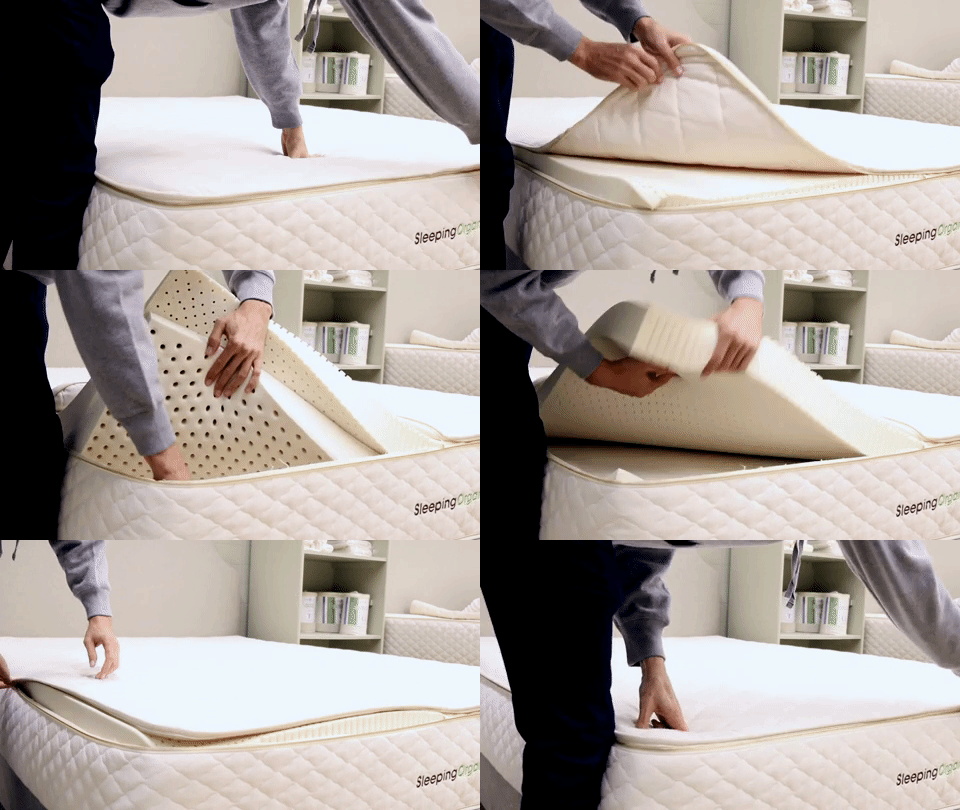
A custom latex mattress with split layers solves this problem. The latex layers inside the mattress are divided down the center, creating two independent sides under a single shared cover. Each partner selects the firmness (ILD) for their own layers. The result: one mattress that feels soft on the left and firm on the right (or any combination you need).
There are two main split configurations:
Split firmness means neither partner compromises on comfort. If preferences change over time, the modular, unglued design lets either partner swap or rearrange their own layers without affecting the other side.
Motion transfer is one of the biggest sleep disruptors for couples. When one person rolls over, gets up for the bathroom, or shifts position, the other person feels it. Over time, this leads to fragmented sleep and daytime fatigue.
Natural latex provides strong motion isolation. The dense, responsive material absorbs movement locally rather than transmitting it across the mattress surface. When one partner moves on their side, the energy is dampened within that area and does not ripple to the other side.
Several factors affect how well a latex mattress isolates motion:
Compared to memory foam, latex provides comparable motion isolation with the added advantage of responsiveness, you do not sacrifice ease of movement for the sake of motion damping.
Size matters more than most couples realize. A queen mattress (60″ wide) gives each partner only 30 inches of personal space, less than a Twin. For two adults, especially if either is a restless sleeper or above average size. This is tight.
| Size | Dimensions | Space Per Partner | Best For |
|---|---|---|---|
| Queen | 60″ x 80″ | 30″ each | Couples with limited bedroom space |
| King | 76″ x 80″ | 38″ each | Most couples, recommended default |
| Cal King | 72″ x 84″ | 36″ each | Taller couples who need extra length |
| Split King (2 Twin XLs) | 76″ x 80″ total | 38″ each (independent) | Couples using adjustable bases |
A king-size mattress is the recommended choice for couples. The 76-inch width gives each person 38 inches of space, close to a Twin XL, and provides enough room for split-layer configurations to work effectively. If your bedroom can accommodate a king, it is worth the upgrade from a queen.
Two bodies generate more heat than one, which makes temperature regulation doubly important for couples. Memory foam is especially problematic here, it traps heat, and the additional body heat from a second person compounds the problem.
Natural latex handles shared-bed temperature better for several reasons:
Couples who have struggled with overheating on memory foam often find that switching to natural latex eliminates the problem entirely.
Edge support is especially relevant for couples because both partners tend to sleep closer to the edges than a solo sleeper would. Weak edge support means the usable sleep surface shrinks, pushing both partners toward the center of the bed.
Latex mattresses do not have reinforced edge support like some innerspring models. This is an honest tradeoff. However, there are ways to maximize edge support in a latex mattress:
For more detail, read about the best latex mattress for side sleepers and options for heavier individuals.
A shared mattress wears faster than a solo one simply because more weight is on it every night. Proper maintenance is essential for longevity:
The modular design of a custom latex mattress makes this maintenance straightforward. Unzip the cover, rearrange the layers, zip it back up. Each partner can maintain their own side independently.
Here is a practical framework for couples selecting a custom latex mattress:
Our Natural Latex Mattress supports all of these configurations, split layers, choice of Talalay or Dunlop for each layer, and a fully removable organic cotton and wool cover.
Yes. A split-layer configuration divides the latex layers into two independent sides under one shared cover. Each partner selects the ILD (firmness) for their own layers. One side can be soft while the other is firm.
Minimal movement will transfer. Natural latex absorbs motion locally, and firmer configurations isolate motion even better. A king-size mattress with split layers provides the best motion isolation for couples.
King size is recommended. It gives each partner 38 inches of personal space (versus 30 inches on a queen) and provides more effective split-layer configurations. If space is limited, a queen with split layers still works but offers less room per person.
No. Natural latex’s open-cell structure promotes airflow, and organic wool covers wick moisture and regulate temperature. Unlike memory foam, latex does not trap body heat, even with two people generating warmth.
A split king consists of two separate Twin XL mattresses placed side by side in a king bed frame. Each mattress is fully independent, allowing different firmness levels and compatibility with adjustable bases where each side raises and lowers independently.
Each partner maintains their own side independently. Every 3-6 months, unzip the cover and flip, rotate, and rearrange the layers on your side. Rotate the overall mattress 180 degrees every 3 months to distribute wear evenly.