Have a saved cart?
Enter your email to restore it.

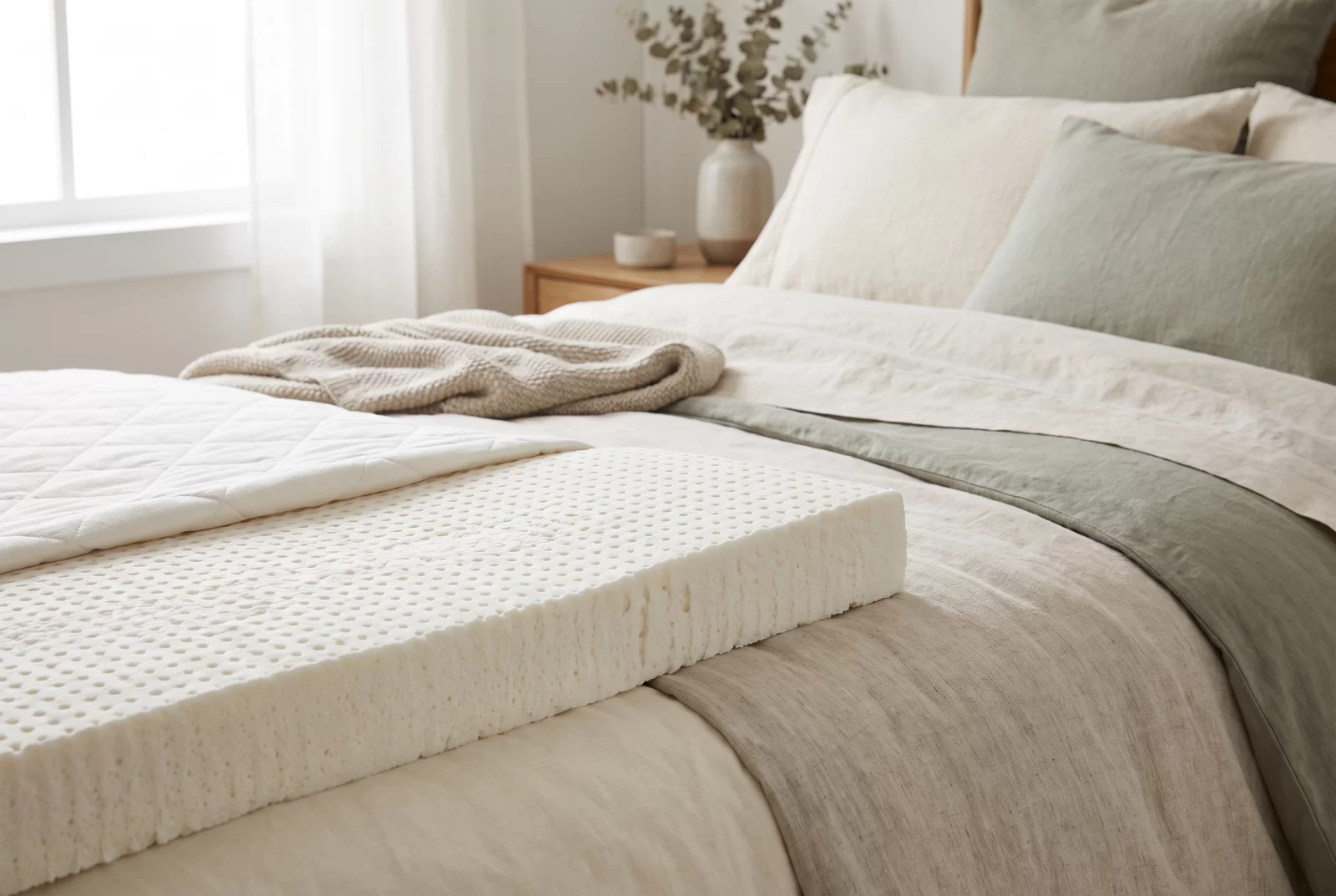
You’ve probably seen the word Talalay attached to mattress toppers and wondered what it means, and whether it’s worth paying more for. It’s a fair question. Latex toppers already sit at the premium end of the market, and Talalay versions typically cost more than their Dunlop counterparts.
Talalay isn’t a different material. It’s a different way of manufacturing latex from the same raw sap, and that process changes the feel, the consistency, and the ideal use case. If you’re shopping for a comfort layer to soften a firm mattress or relieve pressure on your shoulders and hips, understanding Talalay specifically, versus latex in general, will help you spend your money well.
Both Talalay and Dunlop latex start with the same base material: liquid sap harvested from the Hevea brasiliensis rubber tree. The differences show up entirely in how that sap is processed into foam.
In the Talalay process, liquid latex only partially fills a sealed mold. A vacuum is then applied, which pulls the latex outward to fill the mold evenly. The foam is flash-frozen at approximately -22°F to lock the cell structure in place, then vulcanized at around 220°F to cure it. The vacuum and flash-freezing steps are what set Talalay apart: they prevent the latex particles from settling and produce a consistent, uniform, open-cell structure throughout the entire piece of foam.
Dunlop skips the vacuum and freezing steps. The mold is filled completely and cured directly, which is faster, cheaper, and more energy-efficient, but it lets denser particles settle toward the bottom, producing a firmer, denser foam that’s slightly variable from top to bottom.
Because Talalay’s cell structure is uniform and less dense, it has a softer, springier, more plush feel with consistent firmness across the whole surface. That makes it well-suited to the job a topper is trying to do: add cushioning and pressure relief on top of an existing mattress. Dunlop’s denser, firmer character is why it usually shows up in the support core of a mattress rather than in a topper.
You’ll also see this division inside full mattresses. In many natural latex builds, Dunlop is used for the firm support core while Talalay is reserved for the softer top comfort layers. A natural latex topper is essentially that comfort layer sold on its own.
Latex, whether Talalay or Dunlop, behaves fundamentally differently from memory foam or polyfoam. It’s responsive. When you press it, it springs back quickly. You don’t sink in and feel stuck; you feel cushioned but supported, and you can change positions without fighting the material.
Talalay specifically has a lighter, buoyant quality. People often describe it as “springy” or “pillowy.” Dunlop feels more solid and pushback-heavy. Neither is objectively better. They’re different tools for different jobs. For a topper meant to soften a too-firm mattress, most sleepers prefer Talalay.
Most latex toppers sleep relatively cool compared to memory foam or polyfoam, and Talalay’s open, uniform cell structure enhances airflow further. Many Talalay toppers also feature pinhole perforations that increase ventilation. Natural latex maintains decent temperature neutrality and is much less likely to develop the body indentations you see with synthetic foams over time.
Latex mattress toppers typically range from 1 to 4 inches thick. Choosing the right thickness depends on what you’re trying to fix.
A general rule: the firmer your existing mattress and the more pressure relief you need, the thicker the topper should be. If your mattress is already reasonably comfortable and you just want a slight upgrade, a thinner topper avoids over-softening the sleep surface.
Firmness in latex is measured by ILD (Indentation Load Deflection): the pounds of force required to compress a 4-inch latex sample by 25% (to 3 inches thick). Lower ILD means softer; higher ILD means firmer.
For toppers, the useful ranges look roughly like this:
One nuance worth knowing: a 36 ILD Talalay and a 36 ILD Dunlop technically require the same force to compress by 25%, but they don’t feel identical. Dunlop feels firmer to the touch because of its stiffness, though hips can still sink into it under sustained body weight. Talalay feels more even and consistent across the surface.
A topper labeled “natural” or “organic” can mean almost anything unless the latex itself carries independent certification. A few standards matter here.
GOLS (Global Organic Latex Standard) is the only internationally recognized certification specifically for organic latex foam. It requires more than 95% certified organic raw material sourced from rubber plantations certified to USDA NOP or EU organic standards. GOLS also sets permissible limits for harmful substances, emissions, and polymer/filler percentages, and uses transaction certificates at every supply-chain stage to verify traceability from plantation to finished product.
These are independent third-party certifications that verify a topper is free of numerous potentially harmful substances. They don’t address organic status, but they confirm the finished product has been tested for emissions and residual chemicals. Many quality Talalay toppers carry one or both.
For a deeper breakdown of how these standards fit together, see our full guide to how our latex products are made and certified.
Talalay latex toppers can last 10-15 years or longer with normal use. That’s shorter than the 20-25 years commonly cited for denser Dunlop, but still dramatically longer than memory foam or polyfoam toppers, which typically show significant degradation within 3-5 years.
Natural latex is also naturally resistant to dust mites, mold, and bacteria, which makes it a strong choice for allergy-sensitive sleepers. It doesn’t require any added antimicrobial treatments: the resistance comes from the material itself.
To protect a topper investment, we recommend using a mattress protector over the topper. Latex should not be exposed to prolonged direct sunlight (UV breaks it down) and doesn’t need to be flipped, though rotating it 180 degrees every few months evens out wear.
A Talalay topper is a good solution when:
A topper is not the right fix when:
If your existing mattress is worn out, a topper is a temporary patch at best. For a complete solution, a full natural latex mattress with the right firmness built in will outperform any topper-on-old-mattress combination.