Have a saved cart?
Enter your email to restore it.

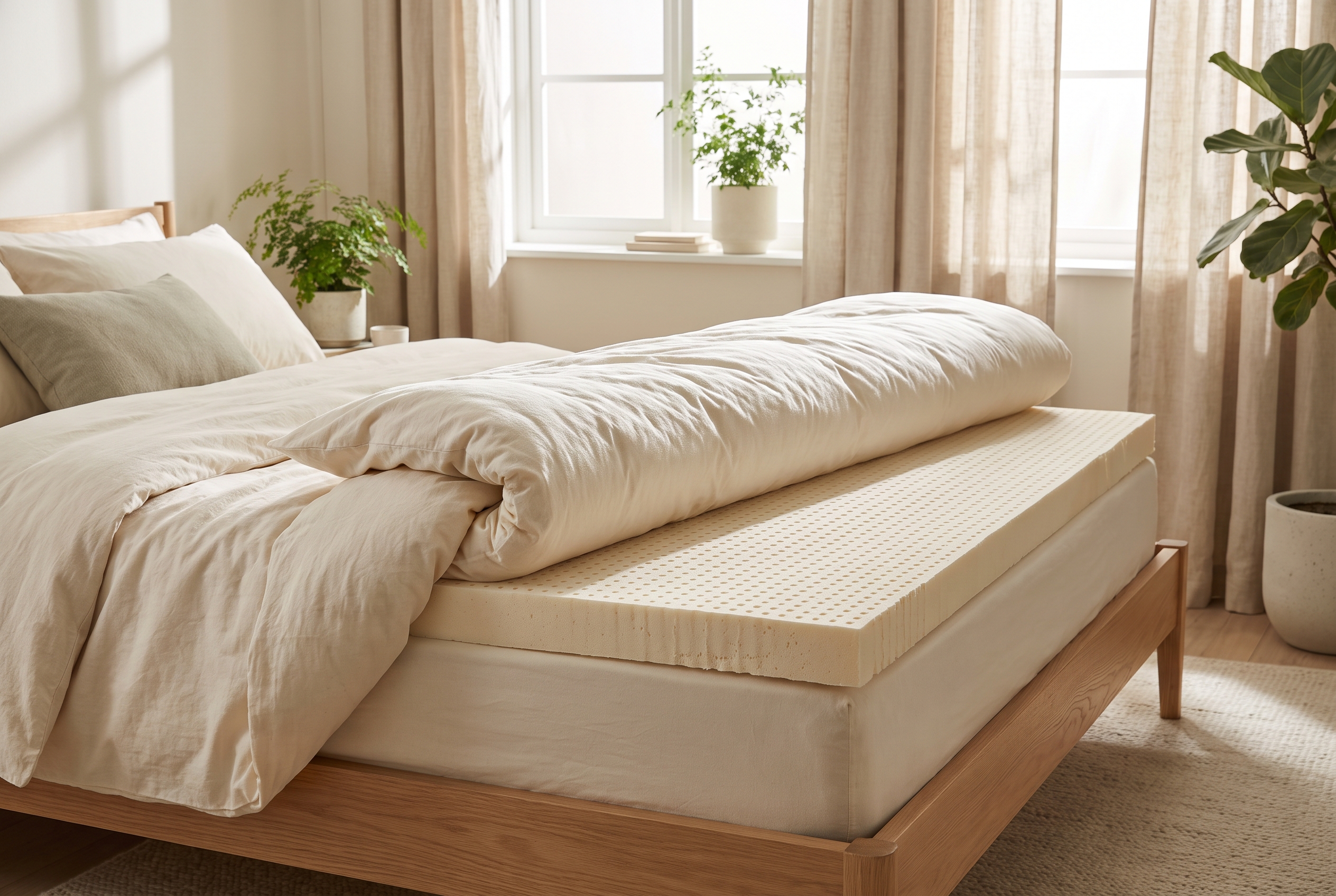
You’ve decided a mattress topper might solve your sleep problem: pressure points, a mattress that feels too firm, or a bed that’s starting to show its age. Then you hit the wall every shopper hits. Dunlop or Talalay? Two inches or three? What does GOLS mean, and is the cheaper option cutting corners?
A Dunlop latex topper is a dense, springy, naturally breathable comfort layer, and the only type of latex that can be certified organic under GOLS. Whether it’s the right buy comes down to matching firmness and thickness to your body, your sleep position, and the mattress underneath it. This guide breaks down how Dunlop latex is made, how it performs, and how to make that match.
Both Dunlop and Talalay latex begin with the same raw material: sap tapped from the Hevea brasiliensis rubber tree. The differences come entirely from what happens after the sap reaches the factory.
The Dunlop process was developed in 1929 and is the older, simpler of the two manufacturing methods. Liquid latex is whipped into an airy batter with a small amount of nontoxic ingredients, poured into a mold, and baked in a vulcanization oven at roughly 212°F. During baking, heavier particles settle toward the bottom of the mold. The finished slab is denser and firmer at the base and slightly softer at the top.
Talalay adds several extra steps: partially filling the mold, vacuum sealing, flash-freezing to around -20°F, then forcing CO2 through the foam to gel it before baking. Those steps produce a lighter, more uniform, more buoyant foam, and consume significantly more energy in the process.
The difference is real but often exaggerated. Both types are produced in a wide range of firmnesses, and a firm Talalay can feel similar to a soft Dunlop. What matters more than the label is the ILD rating and the topper’s thickness.
If organic certification matters to you, and if you’re shopping for natural latex it usually does, this is the single most important fact to understand: GOLS certification is currently available for Dunlop latex, not Talalay. Dunlop is the only form of natural latex that can carry a certified-organic claim.
GOLS stands for Global Organic Latex Standard. It’s administered by Control Union, a globally recognized accreditation body. To qualify, a latex product must:
A topper labeled “natural latex” without a certification is not the same thing as a GOLS-certified Dunlop topper. For a deeper look at what the various certifications verify, see our process.
Latex firmness is measured in ILD (Indentation Load Deflection): the pounds of force required to compress a 4-inch piece of latex by 25%. Most mattress latex falls between 14 (very soft) and 44 (extra firm) ILD.
Where sleep position and body weight suggest different ranges, weight usually wins for support and position wins for surface comfort. A 200-lb side sleeper, for instance, often lands in the medium range rather than the softest.
Thickness controls how much the topper changes the feel of your existing mattress.
Match the thickness to the size of the problem you’re solving. If your mattress feels only slightly off, 2 inches usually does the job. If you’re trying to rescue a bed that feels like a board, go to 3 or 4. For more on how a topper fits into a full sleep system, see our Natural Latex Topper page.
Latex has low point elasticity, which means it compresses over a wider surface area than most memory foam or polyfoam. Rather than forming a deep body-shaped well, it cradles you and redistributes weight across the surface. That’s what produces the classic latex sensation of being supported on the bed rather than sunk into it.
Natural latex has an open-cell structure that promotes airflow. It doesn’t trap heat the way dense memory foam does, which is why latex toppers are frequently recommended for hot sleepers.
Natural latex does not off-gas VOCs and is free from the chemical odors and flame retardants used in many synthetic foams. It’s also naturally hypoallergenic and resistant to dust mites, mold, and mildew, a real advantage for allergy-prone sleepers.
High-quality natural latex toppers can last 8-15 years with proper care. Most memory foam and polyfoam toppers last 3-5 years. Because Dunlop is denser than Talalay of similar quality, it typically lasts longer still.
A topper is a comfort layer, not a support layer. It sits on top of your mattress and follows the contours of whatever is underneath it. That means:
What a topper will do is extend the useful life of a mattress that’s still structurally sound but starting to feel tired, or dial in the comfort of a mattress that’s too firm out of the box. For more on choosing a full mattress rather than layering onto a failing one, see our Natural Latex Mattress.
Latex doesn’t require much maintenance, but a few habits protect your investment:
With this kind of care, a Dunlop topper regularly lasts a decade or more, often outliving the mattress it was purchased to rejuvenate.
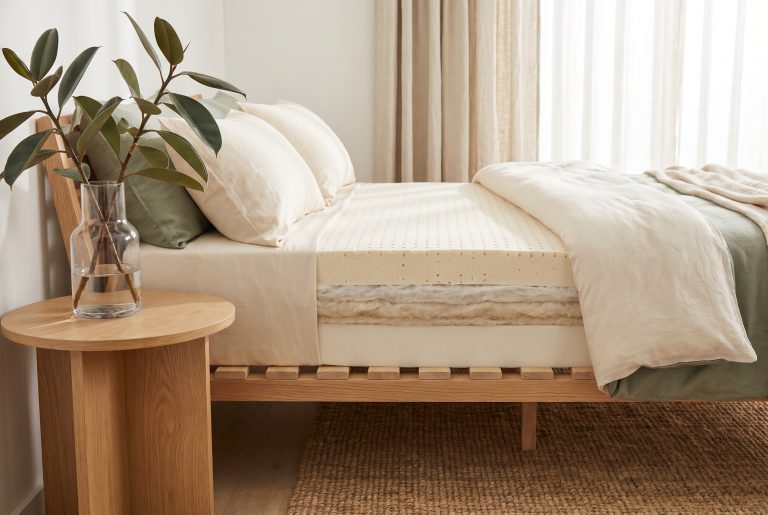
A Dunlop latex topper works best as part of a system where every layer is doing its job. That usually looks like:
Each component supports the others. A great topper on a failing mattress won’t perform. A great mattress with the wrong pillow won’t feel right either. The parts are designed to work together.
Consider a Dunlop topper if:
Reconsider if your mattress is visibly sagging, has broken springs, or is more than 10-12 years old. In those cases, a topper is a stopgap, not a solution.