Have a saved cart?
Enter your email to restore it.

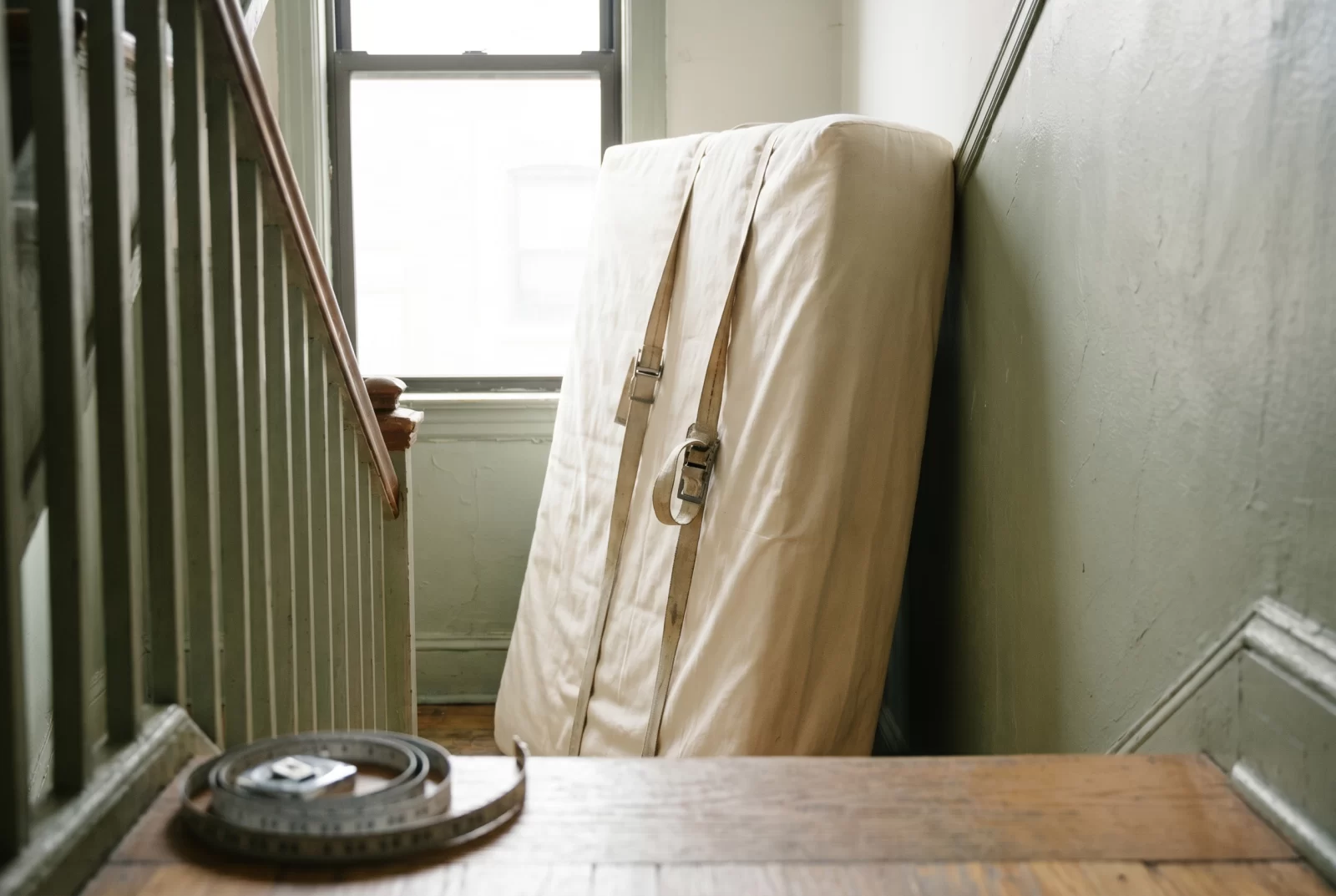
You’re standing in a stairwell, sweating, halfway up the second flight, with a king mattress wedged against the wall and zero leverage. You’re alone. The angle is wrong. Your back is starting to talk to you. And you’re seriously considering whether the kitchen floor is a perfectly fine place to sleep.
This is one of the most common moving disasters, and it’s not because you’re doing anything wrong. A king mattress is heavy, awkward, and not designed to bend around a 90-degree landing. The reliable way to get a king mattress up stairs is to stand it vertically on its long edge, use moving straps, and lift it one step at a time. Before you give up (or hurt yourself), here’s what works, what doesn’t, and where the real risks are.
A king mattress typically weighs between 115 and 180 pounds, and some constructions push past 200. Natural latex mattresses sit at the heavier end of that range: a king all-latex mattress commonly weighs 127 to 165+ pounds depending on thickness and density. Natural latex is denser than synthetic foam, which is why it feels supportive and durable, and also why it’s a beast to move.
For context: OSHA recommends using two or more people any time you’re lifting a load heavier than 50 pounds. A king mattress is two to four times that threshold. So if you’re solo, the goal isn’t to muscle through. It’s to use technique and tools to make the mattress effectively lighter.
Most stairwell disasters happen because the mattress was already going to fail the geometry test. Before you carry anything, walk the path with a tape measure and check:
A king mattress is 76 inches wide and 80 inches long. If your stairwell turns and the diagonal clearance is less than about 80 inches, you’ll have to pivot the mattress vertically to get around the corner, which is doable, but only if you’ve planned for it.
Then clear the path. Pick up rugs, cords, shoes, pet bowls, decorative anything. Put the dog in another room. Wear closed-toe shoes with real traction. A slip on a stair landing while pinned under a king mattress is exactly the injury you’re trying to avoid.
The single most important technique for narrow stairs is to get the mattress vertical. Carrying it flat wastes width, blocks your view, and makes corners impossible. Standing it on its long edge does three useful things:
Tilt the mattress onto its edge on the floor before you start lifting. From there, hug it close to your torso, bend at the knees, keep your back straight, and lift with your legs. Keep your elbows in. When you need to turn, move your feet. Never twist at the waist with the load. Twisting under a heavy load is the most reliable way to strain your lower back.
If there is one piece of gear that turns this job from impossible to manageable, it’s a pair of moving straps or a shoulder dolly. These harnesses loop under the mattress and over your shoulders (or forearms), transferring the weight to your legs and shoulders (the strongest muscles in your body) instead of your hands, biceps, and lower back.
A few things worth knowing:
If you don’t have straps and can’t get them, a long, strong rope or ratchet strap looped around the mattress (with the mattress folded or rolled, more on that below) and slung over a shoulder is a workable improvisation. The friction of the strap on your shoulder is what keeps the load steady; gripping the mattress with your hands alone will exhaust you in one flight.
This is where you have to know what kind of mattress you own.
Mattresses with steel border rods will bend permanently or break if folded. Folding usually voids the warranty. Don’t do it.
Solid memory foam mattresses can be temporarily folded for a move and will regain shape within hours.
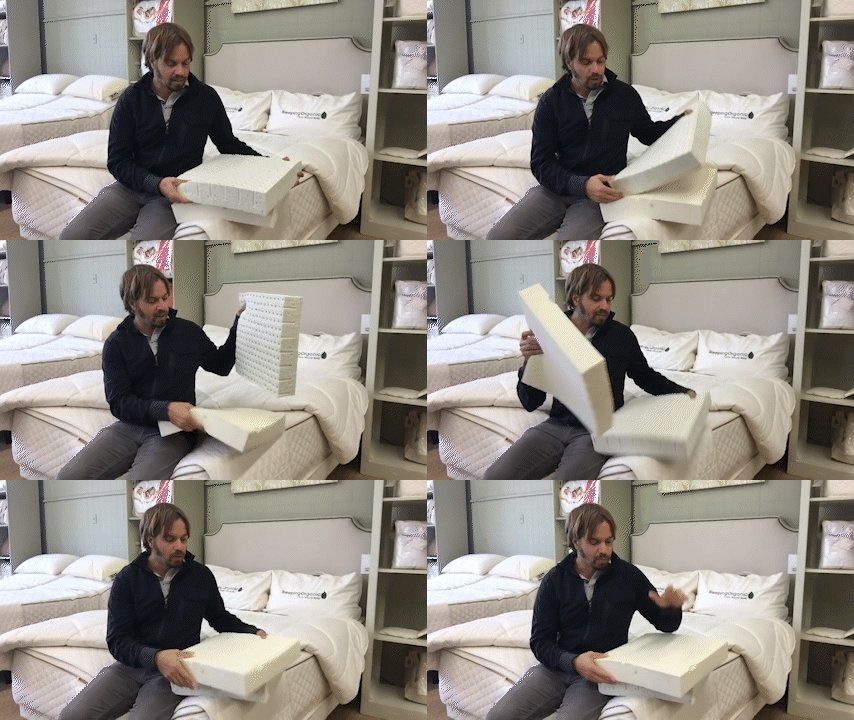
This is the part that matters if you own a natural latex mattress. Latex manufacturers, including ours, generally advise against bending or folding the mattress, because it can damage the structural integrity of the latex layers. Latex is denser and less tolerant of folding than memory foam. Some sources note that solid latex can technically be folded briefly without permanent damage, but it’s a real risk, and pulling or tugging on the latex layers themselves can tear them.
If you own a latex mattress, the better approach is to keep it flat or vertical and use straps, help, or both. If you absolutely must bend it to clear a tight corner, do it gently, briefly, and never crease it sharply. For a deeper look at how to handle and protect a latex mattress, see our Our Process page.
Once you’re at the base of the stairs with the mattress vertical and straps in place:
There’s no medal for finishing this alone. If any of these apply, pause:
Two people make this job dramatically easier. A neighbor, a friend you bribe with pizza, or a couple of hours of professional movers: any of those is cheaper than a back injury or a damaged mattress.
The work isn’t quite done when the mattress is in the bedroom. A latex mattress needs a firm, flat foundation or a slatted base with slats less than 3 inches apart for proper support and airflow. Putting a heavy latex mattress on an old box spring designed for innersprings can crush the box spring and cause sagging from below.
If you’re setting up a new sleep system after a move, an organic mattress foundation built for latex gives you the right slat spacing and firm support. Pair it with a sturdy bed frame and you’ve got a base that won’t fight your mattress.
And if your move ended with you discovering that the mattress you wrestled up two flights of stairs isn’t right for your body, our 365-Day Comfort Program covers comfort adjustments on our Natural Latex Mattress within the first year.
Stand the mattress vertical. Use straps. Measure first. Take the bannister side if you’re solo. Lift with your legs, turn with your feet, and rest on every step. If you own a latex mattress, don’t fold it. And if it’s not working after a serious effort, get a second person. That’s not failure, that’s just physics.