Have a saved cart?
Enter your email to restore it.


Most RV owners don’t realize they have a mattress problem until the first real night on the road. The surface feels thin. The bedroom runs warm. You wake up sore, foggy, and staring at another 300 miles of highway.
That’s not a personal failing or a matter of “getting used to it.” Factory RV mattresses are usually built to fill a platform and hit a weight target, not to support real sleep. RV manufacturers spend the bulk of their budget on engineering, layout, and design. The mattress is where margins get cut.
The good news: this is one of the most fixable weak points in any rig. A better RV mattress, specifically a natural latex one built to fit RV dimensions, changes five things at once: it sleeps cooler, resists the under-mattress mold problem, cuts nighttime tossing, outlasts the foam it replaces by a decade, and leaves you rested enough to drive safely. Here is each one in detail.
RV bedrooms are small, often windowless on one side, and rarely have the same climate control precision as a house. When your mattress traps heat on top of that, night sweats become routine.
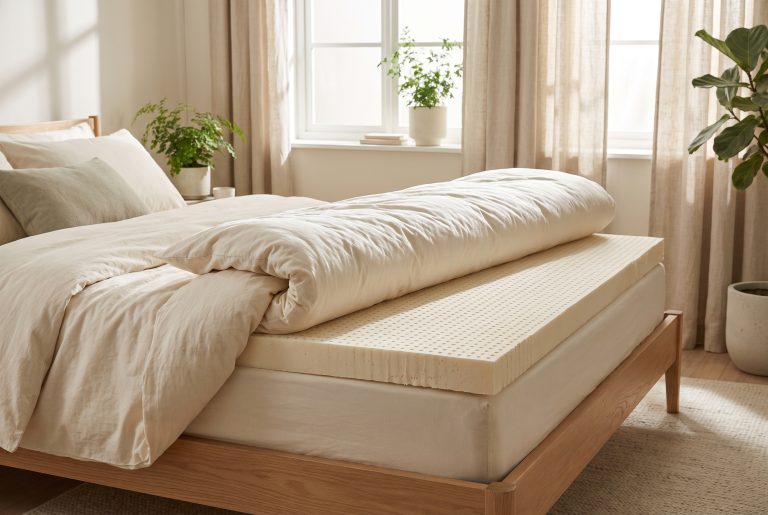
Memory foam is a common culprit. Its dense, closed-cell structure absorbs and holds body heat. Natural latex works differently. It has an open-cell structure with pinholes running through the core, which allows air to move rather than pool. That structural difference is why latex sleeps noticeably cooler than memory foam without needing gels, phase-change covers, or other add-ons.
In a bedroom the size of most RV slide-outs, breathability is not a luxury feature. It is the difference between waking up rested and waking up damp.
This is the RV issue nobody wants to talk about until they lift the mattress and find black spots underneath.
Here’s the physics: your body heat passes through the mattress while you sleep. That warm, moist air meets the cold RV bed frame or plywood platform below. Condensation forms. The area under an RV mattress receives very little airflow to begin with, and RVs are often closed up for weeks or months between trips. Trapped humidity, poor ventilation, and organic material make a mold incubator.
Natural latex is naturally antimicrobial and resists mold and mildew far better than memory foam or low-density polyfoam. It doesn’t eliminate the physics of condensation, but it dramatically reduces how hospitable the mattress itself is to mold growth. Pairing it with a breathable mattress protector and lifting or airing the mattress periodically between trips further reduces risk.
For a bed you may store for weeks at a time in humid climates, material choice matters more than in any residential bedroom.
Sleep is already harder on the road. Unfamiliar noises, uneven campsites, temperature swings, and different daily schedules all conspire against deep sleep. A poor mattress compounds every one of those variables.
Good pressure relief reduces unconscious position changes throughout the night. That matters because the deeper stages of sleep, where your body does its restoration and repair, require sustained stretches of stillness. A thin, unsupportive factory mattress creates pressure points at the hips and shoulders, and your body responds by shifting, waking, and cycling out of deep sleep.
Latex conforms enough to relieve pressure but pushes back with enough support to keep your spine aligned. For most RV travelers, medium-firm is the practical sweet spot: it accommodates side, back, and combination sleepers, and it holds up when sleep positions shift after a long driving day.
If you travel with a partner, an RV bedroom is one of the closest sleeping arrangements you’ll ever share. Latex responds to pressure quickly and isolates motion immediately, so when one person rolls over or gets up early to make coffee, the other isn’t jolted awake. Solo sleepers benefit too, since a calmer surface means fewer micro-arousals from your own position changes.
The average factory RV mattress lasts 5 to 10 years, and many degrade much faster: sagging, developing lumps, or losing whatever thin support they started with. Memory foam mattresses average 5 to 7 years. Innerspring: about 5.
High-quality natural latex has a documented lifespan of 12 to 20 years. It maintains its support profile over time rather than developing the body impressions that plague foam and coil beds. For an RV owner, that math is simple: you replace the mattress once, not three times, over the life of the rig.
Durability also stands up better to the specific stresses of RV life: temperature swings, humidity changes, and the low-level vibration of travel. A latex core doesn’t compress permanently the way lower-density foams do.
If you’re building around a full sleep system, our Natural Latex Mattress can be custom-built to non-standard RV dimensions, including short queen (60 by 75 inches), three-quarter beds, and custom bunk sizes.
This is the point most mattress articles skip, but it’s the most important one for anyone piloting a 10,000-pound vehicle down a two-lane highway.
A 2024 AAA Foundation for Traffic Safety study estimated that 17.6% of all fatal crashes from 2017 to 2021 involved a drowsy driver, roughly 30,000 fatalities over that five-year period and about ten times higher than officially reported figures. NHTSA reported 633 drowsy-driving deaths in 2023 alone and estimates fatigue-related crashes cost society $109 billion annually. About 1 in 25 adult drivers report having fallen asleep while driving in the previous 30 days. A four- to five-second micro-sleep at highway speed covers the length of a football field.
Sleep deprivation from an uncomfortable RV mattress isn’t only a comfort issue. It’s a safety issue. Foggy decisions, slower reactions, and mood impairment all follow poor sleep, and they compound over multi-day trips. The mattress you sleep on the night before a long haul is a variable you can control.
RV queens typically measure 60 by 75 inches, five inches shorter than a residential queen. Slide-out beds usually can’t accommodate mattresses thicker than 6 inches. Some RVs have angled corners, tapered ends, or unusual bunk dimensions. A custom-built mattress lets you specify size, shape, thickness, and firmness rather than compromising on all four.
Conventional mattresses can contain flame retardants, VOCs, and formaldehyde that off-gas into your breathing space for months or years. In a small, poorly-ventilated RV bedroom, that concentration is worse than in any home.
Look for these third-party certifications:
For a deeper explanation of what each certification tests, see how we source and build our mattresses.
These three traits are what separate an RV-appropriate mattress from a residential one that happens to fit. Natural latex delivers all three in a single material, without the trade-offs of foam or coil hybrids.
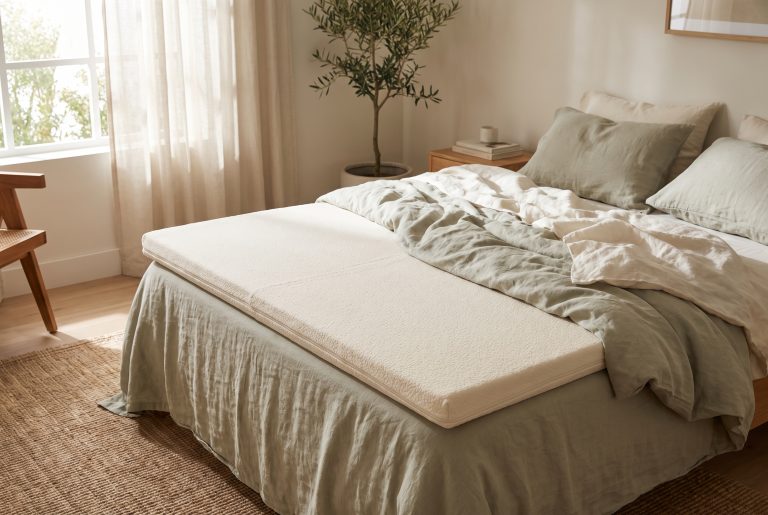
The mattress is the foundation, but a few additions round out the setup for the specific demands of RV travel:
None of this turns an RV into a home bedroom. But it does eliminate the mattress as the reason you wake up sore, sweaty, or too tired to drive.