Have a saved cart?
Enter your email to restore it.


Latex mattress motion transfer is one of the most important factors for couples who share a bed. If your partner tosses, turns, or gets up during the night, you know how disruptive that movement can be. Natural latex mattresses offer excellent motion isolation compared to innerspring mattresses, helping both sleepers rest undisturbed throughout the night.
Motion transfer refers to how much movement travels across the surface of a mattress from one side to the other. When one person shifts position, sits up, or gets out of bed, those vibrations can ripple across the mattress and disturb their partner. A mattress with low motion transfer absorbs and isolates movement, keeping disturbances localized.
High motion transfer is the primary reason many couples end up sleeping in separate beds. Light sleepers are especially sensitive to even small movements, and chronic sleep disruption affects energy, mood, and long-term health.

Natural latex foam has an inherently elastic, resilient cell structure that absorbs energy rather than transmitting it. When pressure is applied to one area of a natural latex mattress, the foam compresses locally and rebounds without sending vibrations across the surface. This is a fundamental property of the material, not something achieved through added technology or gimmicks.
The density and consistency of 100% natural latex contribute to its motion isolation. Unlike innerspring mattresses, where interconnected coils transfer force from one spring to the next, latex foam cells act independently. Each area of the mattress responds only to the weight and movement directly above it.
Understanding how different mattress materials handle motion transfer helps clarify where latex stands.
Memory foam provides the best motion isolation of any mattress material. Its slow-response, viscoelastic structure absorbs movement almost completely. However, memory foam comes with significant trade-offs: it traps heat, off-gasses volatile organic compounds, breaks down faster than latex, and creates a “stuck” feeling that makes it difficult to change positions.
Traditional innerspring mattresses have the highest motion transfer. The coils are physically connected, so movement anywhere on the mattress is transmitted throughout the entire surface. Even individually pocketed coils, while better than open-coil designs, still transfer more motion than foam materials.
Natural latex falls between memory foam and innerspring for motion isolation, offering very good performance without the drawbacks of memory foam. Latex absorbs most movement while remaining responsive and breathable, making it the best overall choice for couples who want motion isolation without sacrificing sleep quality.
If motion transfer is your top priority, certain configurations maximize the isolation properties of a latex mattress.
The most effective solution for eliminating motion transfer is a split latex mattress. In this setup, each side of the mattress contains independent latex layers enclosed in a single mattress cover. Movement on one side has virtually no impact on the other because the layers are physically separated.
Split configurations are available in queen size, but king and California king mattresses benefit the most. The larger surface area combined with independent layers creates two completely separate sleep zones within one bed.
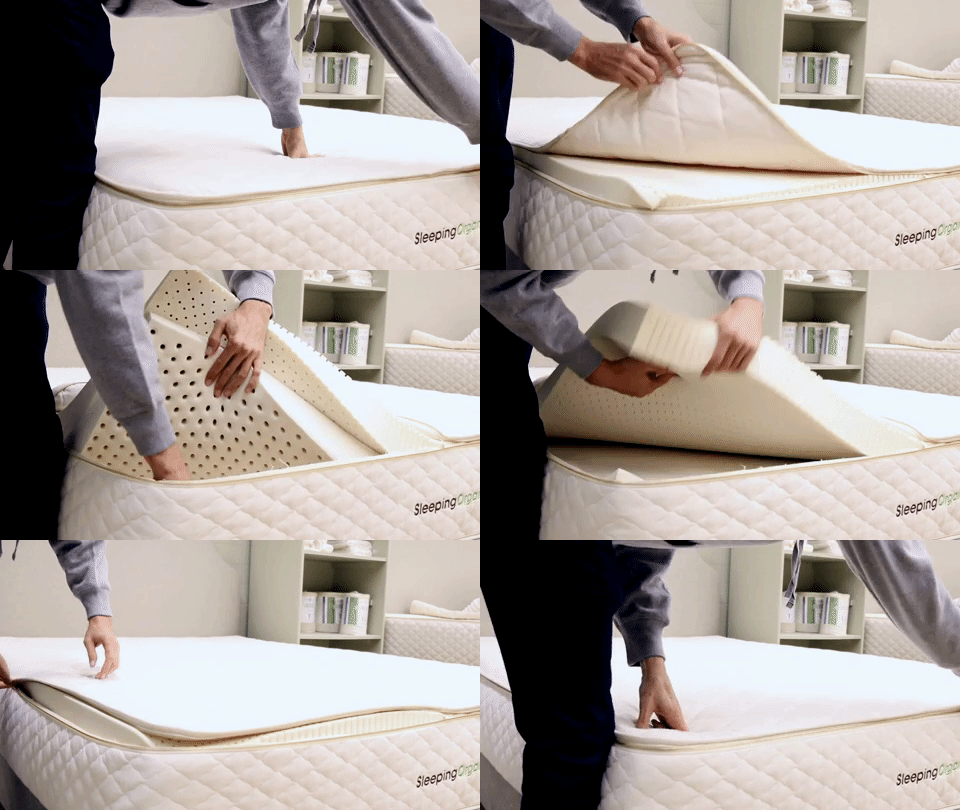
Firmer latex layers transfer less motion than softer ones. A firmer mattress provides more resistance and less sinkage, which helps contain movement to a smaller area. If one partner prefers soft and the other prefers firm, a split configuration lets each person choose their ideal firmness independently.
Thicker mattresses with more layers of latex provide better motion isolation. Each additional layer absorbs more energy before it can reach the other side. A three-layer or four-layer custom latex mattress will outperform a thinner two-layer design for motion isolation.
Your mattress foundation also affects motion transfer. A solid, stable wood slat foundation prevents the mattress from wobbling or shifting, which can amplify motion. Avoid box springs and flexible bases that introduce additional bounce.
A larger mattress naturally reduces felt motion transfer because there is more material between the two sleepers to absorb movement. Upgrading from a queen to a king can make a noticeable difference, even without changing the mattress type.
Side sleepers typically generate more motion transfer than back or stomach sleepers because they are in closer contact with the mattress surface and tend to shift positions more frequently. A supportive latex pillow can help side sleepers find a comfortable position faster, reducing unnecessary movement.
A wobbly or poorly constructed bed frame amplifies every movement. Make sure your frame is sturdy, level, and does not creak or shift when weight is applied.
Many mattress brands use synthetic or blended latex, which does not match the motion isolation performance of 100% natural latex. Synthetic latex has a less consistent cell structure and tends to break down faster, losing its ability to absorb movement over time. A 100% natural or organic latex mattress maintains its motion isolation properties for years longer than synthetic alternatives.
Natural latex mattresses have very low motion transfer. The elastic cell structure of latex foam absorbs movement locally, preventing it from traveling across the mattress. While not quite as isolating as memory foam, latex offers excellent motion isolation without the heat retention and off-gassing issues of memory foam.
A split latex mattress is the best configuration for couples concerned about motion transfer. Each side has independent latex layers, so movement on one side does not affect the other at all. Split configurations also allow each partner to choose their own firmness level.
Memory foam has the absolute lowest motion transfer, followed closely by natural latex. However, natural latex is generally the better overall choice because it combines excellent motion isolation with superior breathability, durability, and responsiveness.
Yes. Firmer mattresses generally transfer less motion than softer ones because the denser material absorbs more energy and allows less sinkage. However, the difference between firmness levels in natural latex is modest compared to the difference between mattress types.
Adding a natural latex topper to an existing mattress can improve motion isolation by adding an extra layer of energy-absorbing material. However, if your underlying mattress has high motion transfer, such as an innerspring, a topper will only partially address the problem.
Larger mattresses reduce felt motion transfer because there is more material between the two sleepers. A king or California king provides significantly better isolation than a full or queen, simply due to the additional surface area separating each person’s sleep zone.