Have a saved cart?
Enter your email to restore it.

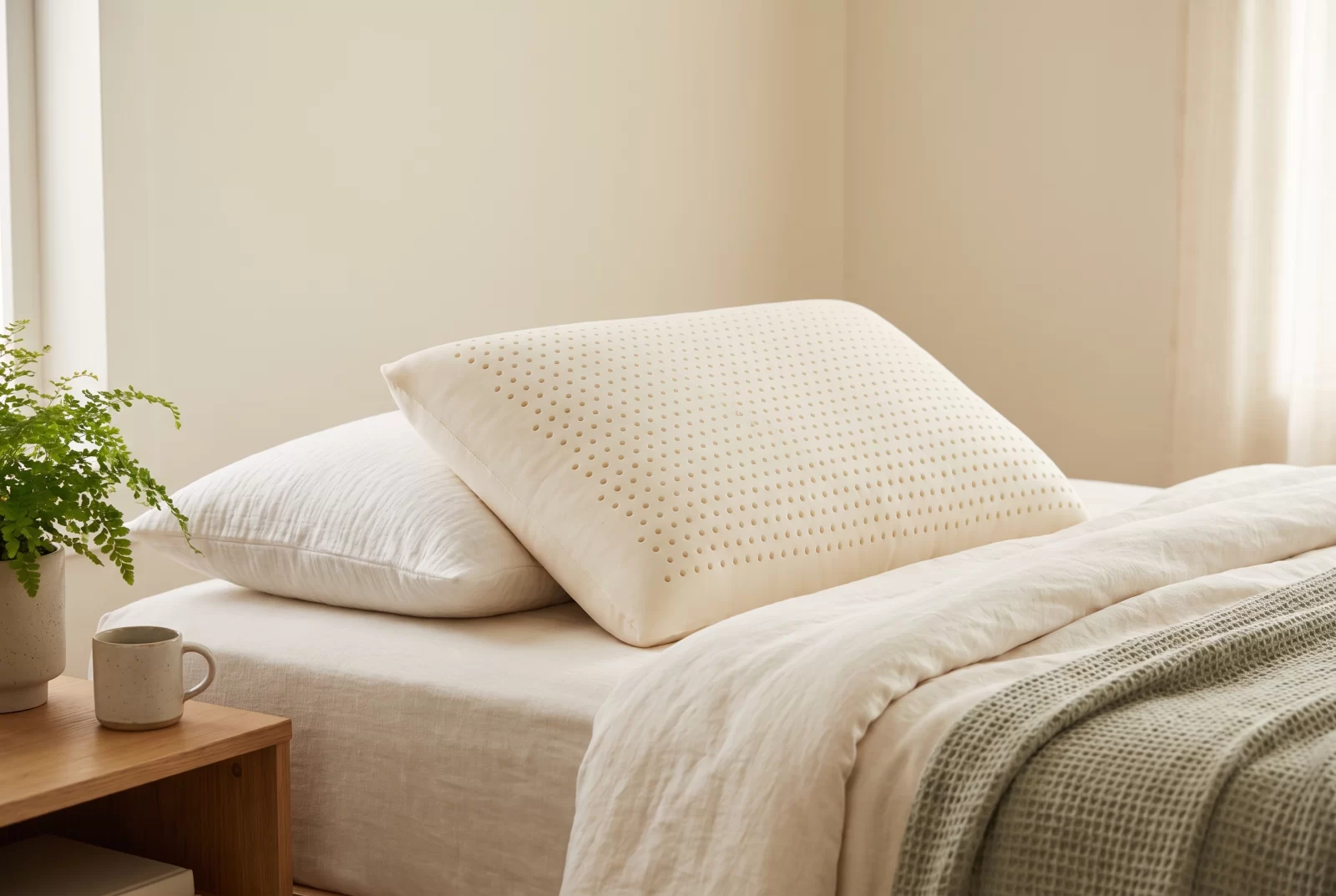
Most people shopping for a natural latex pillow run into the same fork in the road: Dunlop or Talalay. The labels sound technical, the marketing copy is thin, and it’s not always clear what you’re buying.
Dunlop and Talalay are manufacturing processes, not types of rubber. A Dunlop latex pillow is rubber-tree latex foam poured and baked in a single pass, which makes it denser and firmer than Talalay, a feel that suits side and back sleepers best. The label alone doesn’t tell you whether the latex inside is natural, blended, or synthetic. But the process does shape how the pillow feels, how long it lasts, and how it holds up night after night.
This guide walks through what a Dunlop latex pillow is, how it’s made, who it tends to suit best, and what to look for on a label before you buy.
Dunlop is the older of the two main latex manufacturing methods. It was invented in the late 1920s by E.A. Murphy, an engineer working with liquid latex from the rubber tree (Hevea brasiliensis).
The process is straightforward. Liquid latex sap is whipped into a froth, mixed with vulcanizing and gelling agents, poured into a mold, then baked (vulcanized) in a single continuous pass. After baking, the foam is washed and dried. The result is a dense, resilient foam with an open-cell structure and, in most pillow applications, small ventilation channels called pincores.
Compared to Talalay, which adds a vacuum-and-flash-freeze step before baking, Dunlop is simpler, more energy-efficient, and less expensive to produce. That cost difference is why most natural latex pillows on the market use Dunlop. In one independent test of 21 natural latex pillow brands, only 6 used Talalay.
Dunlop tends to be firmer and denser than Talalay. Some describe the feel as a stack of folded shirts: supportive, structured, with a slight give but no sink. It responds quickly when you change positions and doesn’t develop the slow, molasses-like compression that memory foam is known for.
Talalay, by contrast, feels lighter and more airy. It’s springier and softer at similar loft. Both processes can produce excellent pillows; they’re just different feels serving different preferences.
Dunlop shows up in two pillow formats, and the difference matters more than most people realize.
A solid Dunlop pillow is a single molded piece of latex foam, usually with pincore ventilation holes running through it. It’s structured, stable, and holds its shape consistently. You get whatever loft and firmness the manufacturer built, with no adjusting after the fact.
Solid Dunlop is a good fit for sleepers who already know what loft they need and want a pillow that behaves the same way every night for years.
Shredded Dunlop pillows contain small pieces of Dunlop latex foam inside a fabric shell. Because you can add or remove fill through a zippered opening, the loft and firmness are adjustable. This is why Dunlop is the standard for shredded latex pillow fill: its density holds loft well and resists compressing into a flat pancake over time.
A shredded latex pillow is often the better choice if you’re between sleep positions, share opinions with a partner about pillow height, or simply aren’t sure what loft works best for your neck.
Loft and firmness matter more than the specific process, but Dunlop’s density profile suits some sleepers better than others.
Side sleepers generally need a higher-loft, firmer pillow to fill the space between the head, neck, and mattress and keep the spine level. Dunlop’s density holds that loft under weight instead of collapsing. Testing at the Sleep Foundation found side sleepers often preferred around 5 inches of loft to buffer between head and shoulder for even alignment.
Back sleepers do best with medium loft, roughly 3 to 5 inches, supporting the natural cervical curve without pushing the head forward. Both solid and shredded Dunlop work here, especially adjustable shredded versions that let you dial in the exact height.
Stomach sleepers are the exception. They typically need a thin pillow (1 to 3 inches) or none at all, and a dense Dunlop pillow can be too firm or too high, flexing the neck forward and creating strain at the base of the skull. If you’re a dedicated stomach sleeper, a shredded Dunlop pillow with most of the fill removed is usually a better option than a solid one.
Latex pillows are among the most durable pillows made. Sleep Doctor puts the typical latex pillow lifespan at 2 to 4 years, longer than down or feather (1 to 3 years) and significantly longer than polyester (1 to 2 years). NapLab notes some latex pillows last 5 to 10 years or more with proper care.
Dunlop tends to sit at the longer end of that range because it’s denser than Talalay. It resists compression, doesn’t clump, and won’t flatten overnight the way fiberfill or down can.
To get the full lifespan, protect the pillow. A breathable, washable pillow protector shields the latex from oils, sweat, and dust. And keep it out of direct sunlight, since UV degrades natural rubber over time.
Latex pillows sleep noticeably cooler than memory foam. The reason is structural: latex has an open-cell foam structure, and Dunlop pillows are almost always molded with pincore ventilation holes that promote airflow. Memory foam has an irregular closed-cell structure that traps heat.
Latex is also naturally resistant to dust mites, mold, and mildew. The dense foam structure doesn’t hold moisture the way down or fiberfill does, so it doesn’t create the humid environment those allergens need.
The one caveat is latex allergy. Natural latex sap contains 15 recognized allergenic proteins (Hev b 1 through Hev b 15), with Hev b 5 and Hev b 6.01 being the primary sensitizers. However, the extensive washing that happens during Dunlop manufacturing removes nearly all the allergy-causing proteins from the finished foam. Most people with a mild latex sensitivity tolerate a washed, cured latex pillow without issue. If you have a diagnosed Type I latex allergy, talk to your allergist before introducing any latex product into your bedroom.
This is where the label matters most. Dunlop and Talalay describe the process, not the material. A Dunlop pillow can be made from 100% botanical Hevea sap, or it can be blended with SBR (styrene-butadiene) synthetic latex to cut cost. The label “Dunlop” alone doesn’t tell you which.
Two distinctions worth knowing:
The most reliable way to verify what’s inside is to look for third-party certifications.
GOLS is the only internationally recognized certification specifically for organic latex foam. To carry the GOLS mark, a product must contain at least 95% certified organic latex by weight, verified through independent third-party auditing. If a Dunlop pillow is GOLS-certified, you know it’s overwhelmingly natural latex from certified organic rubber tree operations.
OEKO-TEX Standard 100 is a chemical safety certification that tests finished products against over 1,000 harmful substances, including heavy metals, formaldehyde, and other prohibited chemicals. It doesn’t verify “organic,” but it does verify that what you’re putting your face on isn’t off-gassing something concerning.
Well-made natural latex pillows often carry both. When they do, you have documented proof of both material purity and chemical safety, not a marketing claim.
A pillow is one piece of the sleep system, and it works best when the rest of the setup is aligned with it. A high-loft pillow on a soft, sagging mattress won’t hold your neck where it should be, because your shoulder is already sinking too far. A firm Dunlop pillow paired with a supportive latex mattress and foundation gives your cervical spine a stable reference point.
If you’re building out a fully natural setup, an organic latex mattress paired with a proper mattress foundation gives the shredded or solid Dunlop pillow something to work against. For a deeper comparison between the two latex processes, see our detailed guide on Dunlop vs. Talalay latex.