Have a saved cart?
Enter your email to restore it.

If you’ve shopped adjustable beds recently, you’ve probably seen a dozen brand names and wondered whether you’re actually comparing different products. In most cases, you’re not. Leggett & Platt, a Missouri-based manufacturer founded in 1883, is the largest U.S. maker of adjustable bed bases and supplies private-label bases to more Top 25 bedding retailers than any other company. Even Sleep Number’s FlexFit bases, which can run up to $10,000, are manufactured by Leggett & Platt and warrantied through them.
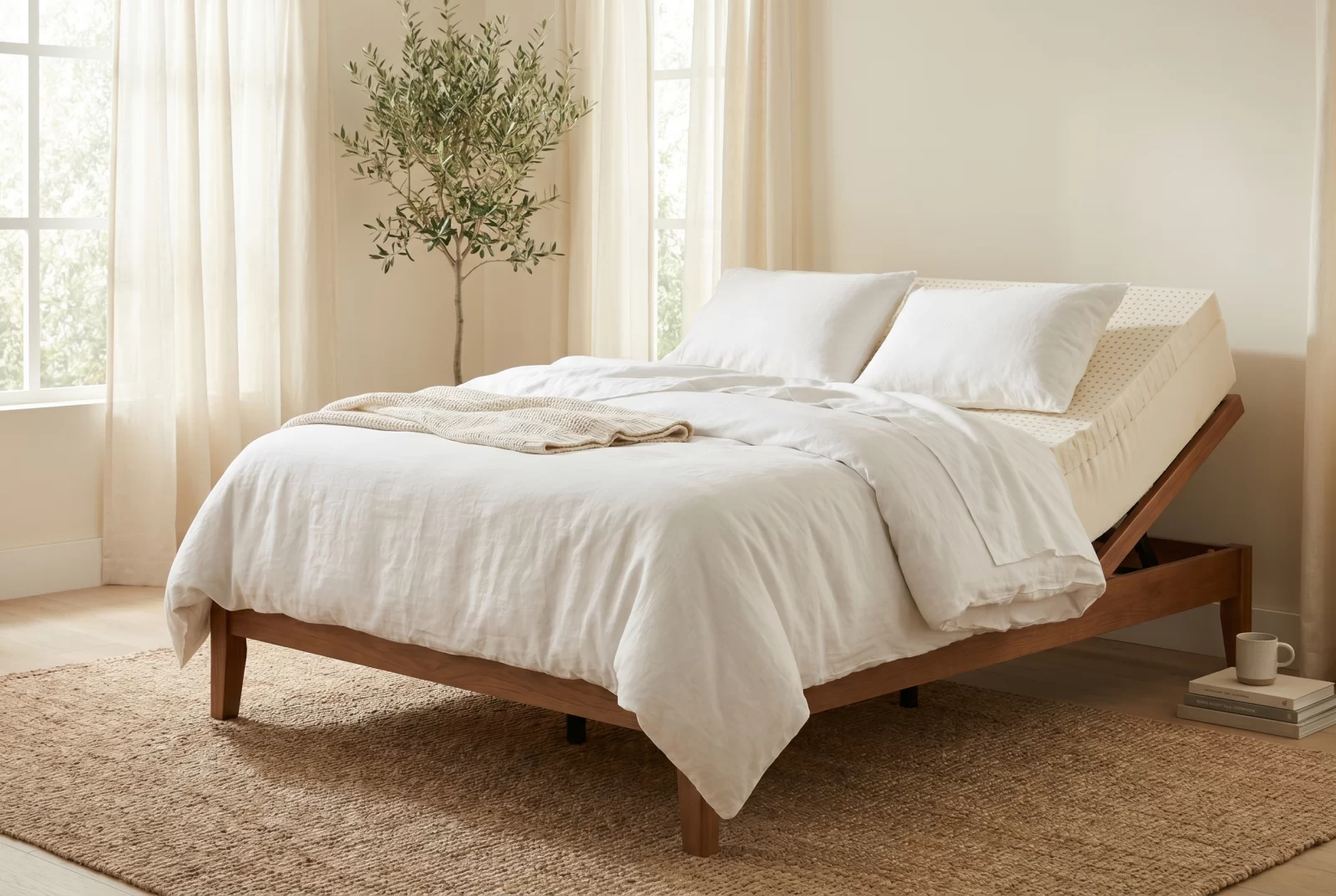
That matters if you own (or are considering) a natural latex mattress. Latex pairs well with a Leggett & Platt adjustable base: it flexes with the articulation and recovers without damage, as long as the base has a solid platform and a lift capacity of 750 pounds or more. The adjustable base is the mechanical foundation your mattress flexes on thousands of times over its lifespan. The wrong pairing shortens the life of a good mattress. The right pairing lets latex do what it does best across every position: conform, support, and breathe.
This guide covers how Leggett & Platt bases are built, why latex pairs well with them, the feature differences across the line, and the practical questions buyers ask most often.
Leggett & Platt began in 1883 with the invention of the steel coil bedspring and started manufacturing adjustable bases more than 40 years ago. All of their adjustable beds are made in the USA at plants in Joplin, Missouri and Georgetown, Kentucky. They don’t sell directly to consumers. Their bases reach you through authorized retailers, and often under a private label you’d never associate with the parent company.
A few things follow from this scale:
A mattress on an adjustable base has to bend repeatedly, at the head and often at the foot, without losing its internal structure. That’s where natural latex has a mechanical advantage over most other mattress types.
Latex is flexible and resilient. It conforms when the base articulates, then returns to its original shape without developing memory at the hinge points. It also stays cooler than memory foam in an inclined position, where airflow through the mattress matters more because you’re often sitting up to read or watch something rather than lying flat.
Spindle, another natural latex mattress maker, specifically recommends Leggett & Platt adjustable platforms for latex. Their reasoning is worth repeating: wire or mesh-grid foundations designed for innersprings aren’t supportive enough for latex. When force is applied, the grid bends and sags. A solid platform with metal under-support and a motor with a 750+ lb lift capacity is what latex needs. Leggett & Platt’s base design meets those criteria.
Our Natural Latex Mattress is built with this kind of use in mind. The layers flex with the base rather than fighting it, which is why we routinely recommend an adjustable foundation to customers who want to read, work, or manage reflux without stacking pillows. If you’d rather get the mattress and base from one place, the Ergomotion Rio 4 adjustable bed is the base we carry and recommend, and it meets the same platform and lift-capacity criteria.
Both work. Dunlop is slightly denser and firmer by nature; Talalay is a bit more pillowy and springy. Neither type has a mechanical problem with articulation. The question that matters more is total mattress thickness and the weight of the mattress relative to the base’s lift capacity. A 10- to 12-inch natural latex mattress on a base with 750+ lb lift capacity is a conservative, reliable match.
Leggett & Platt currently offers 14 adjustable bed models across three tiers: classic, premium, and performance. Rather than walk through each SKU, it’s more useful to know the feature categories and which ones affect how the bed feels to use.
Pair a base like this with the right sleep accessories and the system works together. A shredded latex pillow is worth mentioning here. It’s adjustable in loft, so you can remove or add fill to match the angle of the base’s pillow tilt without ending up with your neck craned.
Zero Gravity is the single feature most often cited in adjustable bed marketing, and it’s worth understanding what it is and isn’t.
The position was originally developed by NASA to reduce pressure on astronauts’ bodies during takeoff. On an adjustable bed, it elevates the legs and head so body weight distributes more evenly and the spine sits in a neutral position. In practice, pressure on the lower back is reduced, and for many people the position opens the airway enough to reduce snoring. Research on over 1,000 nights of sleep data found sleeping on an incline was associated with a roughly 7% reduction in snoring duration.
That’s a real effect, but a modest one. The Banner Health medical team notes that while adjustable beds can help with sleep-disordered breathing, GERD, and mobility issues, many broader claims about circulation, blood pressure, digestion, and insomnia aren’t backed by solid research. The National Council on Aging makes the same point and recommends talking with your doctor before investing if you’re buying for a specific medical issue.
An adjustable base is a comfort and position tool first and a medical device second. Buy it for what it demonstrably does.
Yes. The adjustable base takes the place of both the box spring and the bed frame: it has its own legs. If you want to keep an existing bed frame, you can usually set the base inside the frame after removing the slats. Most standard bed frames accommodate this, but measure the inside dimensions first. If you’re not using an adjustable base, our Mattress Foundation is the flat, solid platform we recommend for latex.
Yes. Leggett & Platt bases can attach to most standard-size headboards using a headboard bracket kit. The kit bolts the base to the headboard so they move as one unit.
Standard fitted sheets work on single-piece adjustable bases. Split king configurations, two twin XL bases pushed together so each side articulates independently, require two twin XL fitted sheets. Our organic sheet sets are available in both sizes.
Generally, no. Adjustable beds are typically non-returnable across the industry: they’re heavy, they’ve been electronically installed, and the logistics of moving them back are significant. This makes the trial period on your mattress (not the base) the more important safeguard. Our 365-Day Comfort Program covers the latex mattress side of the equation.
The National Council on Aging’s guide puts the average cost of adjustable beds between $899 and $1,599. That’s a reasonable range for a mid-tier base. Premium models with pillow tilt, lumbar support, and app control run higher. When you’re pricing a base specifically to pair with a latex mattress, plan on spending upward of $1,500 to get the motor capacity and platform construction that latex needs long-term.
An adjustable base makes sense if you:
It’s less essential if you sleep flat on your back or side without any of the above, and you’d rather invest that money in the mattress itself or in bedding. The mattress determines how you sleep. The base determines what positions are available to you.