Have a saved cart?
Enter your email to restore it.

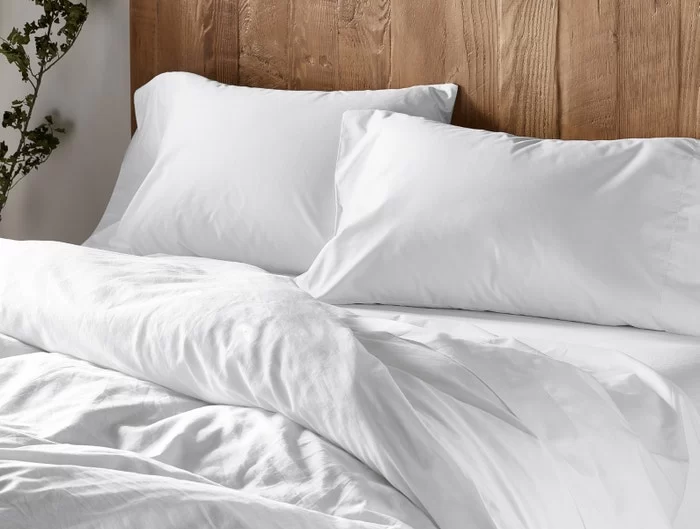
You chose an organic mattress to eliminate chemicals from your sleep environment. But if you cover it with conventional sheets. You are reintroducing many of the same substances you paid to avoid. Conventional cotton sheets carry pesticide residues, formaldehyde-based wrinkle treatments, and synthetic dyes that sit directly against your skin all night.
The best organic sheets for an organic mattress are GOTS-certified, made from 100% organic cotton, and free from chemical finishes. Here is how to choose the right ones.
The word “organic” is unregulated when used on its own in bedding marketing. The only reliable way to verify organic sheets is through third-party certification.
GOTS (Global Organic Textile Standard) is the gold standard. A GOTS-certified sheet set means:
If a product claims to be organic but does not carry GOTS certification, be skeptical. Terms like “natural,” “eco-friendly,” and “made with organic cotton” do not carry the same verification standards.
Organic cotton sheets come in two primary weaves, and each has a distinct feel:
Neither is better overall, it depends on your temperature preferences and how you like your sheets to feel. If you sleep hot, go with percale. If you prefer a smoother, warmer feel, choose sateen.
Thread count gets more attention than it deserves. For organic cotton sheets, the ideal range is 200 to 400 threads per square inch. Within this range, the sheets are soft, durable, and breathable.
Sheets marketed at 800 or 1000 thread count typically use multi-ply yarns to inflate the number. These sheets are often thinner, less breathable, and less durable than a honest 300-thread-count organic cotton sheet. Focus on the quality of the cotton and the certification, not the thread count.
Organic latex mattresses are often thicker than conventional mattresses, typically 9 to 12 inches. If you add a mattress protector, the total height increases further. Make sure the fitted sheet pocket depth accommodates your mattress height.
Look for sheets with deep pockets (at least 14 inches) and strong elastic that holds the sheet in place. A fitted sheet that pops off the corners during the night is one of the most common complaints with new sheets, and it is almost always a depth issue.
Organic cotton sheets are easy to care for and get better with age:
For more on why organic cotton sheets outperform conventional options, read our guide on whether organic sheets are really better. For background on how organic cotton is used in mattress construction, see our piece on organic cotton in latex mattresses.
New organic sheets may feel slightly stiffer than conventional sheets that have been treated with chemical softeners. However, organic cotton breaks in naturally and becomes noticeably softer after a few washes. Most people find them more comfortable long-term.
Yes. GOTS-certified organic sheets eliminate pesticide residues and chemical finishes from your sleep surface. They also tend to last longer because the untreated fibers maintain their integrity better over time.
Between 200 and 400. This range provides the best combination of softness, breathability, and durability. Avoid sheets with inflated thread counts above 600, as these typically use inferior multi-ply construction.
You can, but conventional sheets may contain pesticide residues and chemical finishes that come into direct contact with your skin and your mattress. If you invested in an organic mattress to avoid chemicals, organic sheets complete that commitment.
Every one to two weeks is ideal. Organic cotton sheets are durable and hold up well to regular washing. Washing more frequently is fine if you sweat heavily during sleep.
Some initial shrinkage (3 to 5 percent) is normal with organic cotton, especially in the first wash. Washing in cold water and tumble drying on low minimizes shrinkage. Quality organic sheet sets account for this with slightly larger pre-wash dimensions.