Have a saved cart?
Enter your email to restore it.

Side sleeping is the most common sleep position, and it places unique demands on a mattress. When you lie on your side, your shoulder and hip protrude significantly below your torso’s midline. On a surface that’s too firm, those pressure points bear the full load of your body weight, leading to numbness, aching joints, and disrupted sleep. On a surface that’s too soft, your spine sags out of alignment, creating a different set of problems.
The sweet spot for side sleepers is a mattress that does two things simultaneously: contours deeply enough to relieve pressure at the shoulder and hip, while providing enough support underneath to keep the spine neutral. Natural latex does both better than any other material, because it’s uniquely capable of surface-level softness with structural resilience underneath.
This guide breaks down exactly what side sleepers need, which latex configurations work best by body weight, and how to build a natural latex mattress that fits your specific body.
When you’re lying on your side, your shoulder and hip are the widest parts of your body. A well-matched mattress should allow those areas to sink in slightly so the rest of your spine, from neck to tailbone, floats in a straight, horizontal line. If your mattress is too firm, your shoulder is pushed upward, creating a lateral curve in your cervical spine. If it’s too soft, your hip sinks too far, creating a downward curve in your lumbar spine.
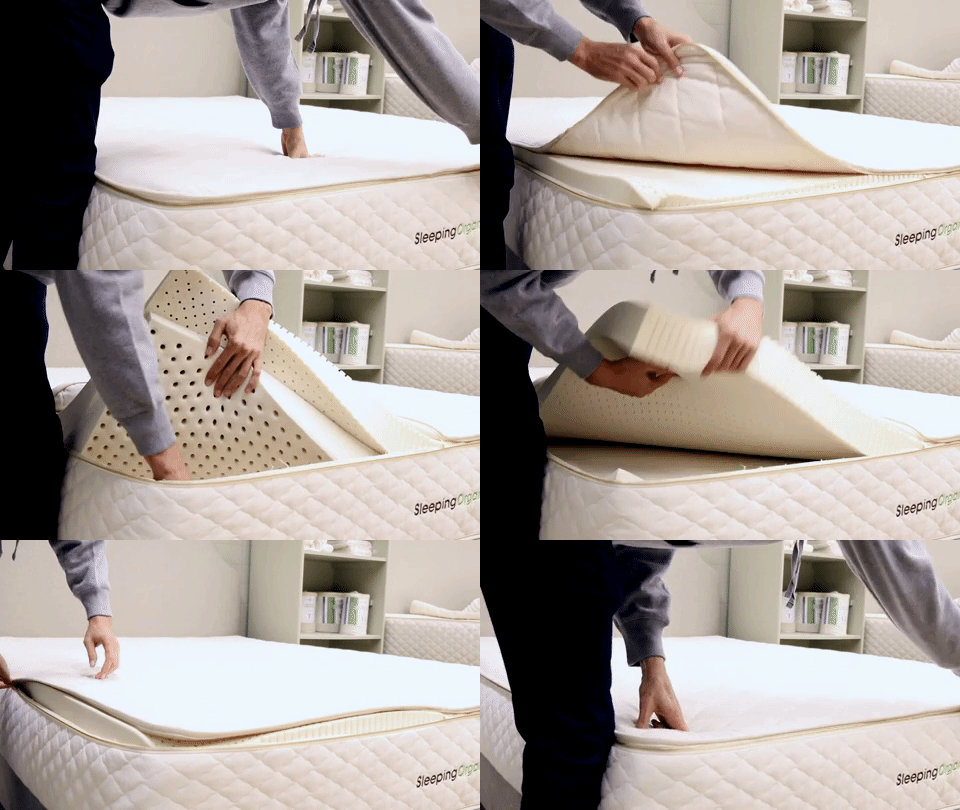
Latex mattresses solve this in a way that memory foam and innerspring cannot. Latex is elastic, meaning it pushes back with equal force to what you put in. It cradles where you need it most, and returns to shape instantly when pressure is removed. There’s no “stuck in a hole” feeling, no heat buildup, and no gradual sag over time.
For a deeper look at how latex compares to other mattress types overall, see our post on latex mattress pros and cons.
Both Dunlop and Talalay latex can work well for side sleepers, but they have different characteristics that make each better suited to specific layers in the mattress.
Talalay latex is produced using a vacuum and flash-freeze process that creates a more consistent, open cell structure. The result is a softer, springier feel with excellent point elasticity, meaning it contours closely to curved body shapes. For side sleepers, Talalay is an ideal comfort layer material because of this contouring ability.
Dunlop latex is denser and slightly firmer at equivalent ILD ratings, with a more supportive, grounded feel. It excels as a support or transition layer, providing the stable base that keeps the hip from sinking too far.
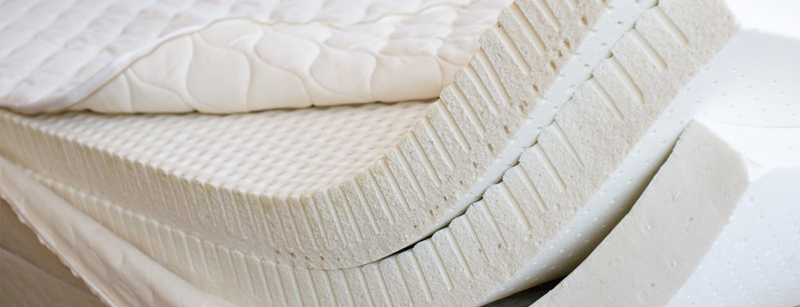
A common and highly effective configuration for side sleepers is a soft Talalay comfort layer over a medium or firm Dunlop support layer. The Talalay absorbs the shoulder and hip, while the Dunlop holds the lumbar region steady.
For a full comparison of these two materials, read our guide on Dunlop vs. Talalay latex.
ILD (Indentation Load Deflection) measures latex firmness. The higher the ILD number, the firmer the latex. Here’s a practical reference:
| ILD Range | Feel | Best Use for Side Sleepers |
|---|---|---|
| 14–19 ILD | X-Soft Talalay | Comfort/top layer for lighter sleepers |
| 19–22 ILD | Soft | Comfort layer for average-weight side sleepers |
| 30–32 ILD | Medium | Transition or base layer; comfort layer for heavier sleepers |
| 30–32 or 37–40 ILD | Medium or Firm | Support/base layer for most side sleepers |
| 37–40 or 44 ILD | Firm or X-Firm | Base layer for heavier sleepers (200+ lbs) |
Side sleepers generally want their comfort layer in the 14–19 or 19–22 ILD range, with firmer layers underneath for support. The exact combination depends significantly on body weight.
Body weight determines how deeply you compress a mattress layer. A 120-pound person lying on a 30–32 ILD comfort layer will experience a different depth of compression than a 230-pound person on the same layer. Getting this right is why one-size-fits-all mattresses fail so many sleepers.
Lighter side sleepers don’t compress mattress layers as deeply, which means they need genuinely soft materials to achieve adequate pressure relief. A soft-to-medium mattress that feels comfortable to an average-weight person may actually be too firm for someone under 130 lbs.
Recommended comfort layer: X-Soft Talalay, 14–19 ILD
Recommended support layer: Medium Dunlop, 30–32 ILD
The Sapling (9″, 2-layer) with a soft Talalay top and medium Dunlop base is an excellent fit for lightweight side sleepers who don’t need additional transition layers.
This range covers the majority of side sleepers, and it’s where the most configuration flexibility exists. A Soft comfort layer provides good pressure relief, while a Medium or Firm base keeps the spine supported.
Recommended comfort layer: Soft Talalay, 19–22 ILD
Recommended transition layer (if using 3+ layers): Medium Talalay or Dunlop, 30–32 ILD
Recommended support layer: Medium or Firm Dunlop, 30–32 or 37–40 ILD
The Sprout (10″, 3 layers) is ideally suited to this weight range, providing enough layering to fine-tune both pressure relief and spinal support.
Heavier side sleepers compress latex more deeply, which means a comfort layer that’s too soft will allow the hip to sink past the support layer’s reach. The solution is a slightly firmer comfort layer paired with a firm base.
Recommended comfort layer: Medium Talalay, 30–32 ILD
Recommended transition layer: Medium or Firm Dunlop, 30–32 or 37–40 ILD
Recommended support layer: Firm Dunlop, 37–40 or 44 ILD
The Tree (13″, 4 layers) is the best match for heavier side sleepers. The additional layers allow for a gradual firmness gradient from top to bottom, which provides deep pressure relief without sacrificing hip support.
| Body Weight | Model | Top Layer | Middle Layer(s) | Base Layer |
|---|---|---|---|---|
| Under 130 lbs | Sapling (9″) | X-Soft Talalay (14–19 ILD) | , | Medium Dunlop (30–32 ILD) |
| 130–200 lbs | Sprout (10″) | Soft Talalay (19–22 ILD) | Medium Dunlop (30–32 ILD) | Medium or Firm Dunlop (30–32 or 37–40 ILD) |
| 200+ lbs | Tree (13″) | Medium Talalay (30–32 ILD) | Medium or Firm Dunlop (30–32 or 37–40 ILD) x 2 | Firm or X-Firm Dunlop (37–40 or 44 ILD) |
| Combo Sleeper (side/back) | Sprout or Tree | Soft Talalay (19–22 ILD) | Medium Dunlop (30–32 ILD) | Firm Dunlop (37–40 ILD) |
Many side sleepers also spend time on their back or occasionally drift to their stomach. If you shift positions regularly, your mattress needs to accommodate multiple sleep positions without compromising any of them.
For side/back combination sleepers, a Soft Talalay comfort layer (19–22 ILD) is the best compromise, soft enough to relieve shoulder and hip pressure when side sleeping, but not so soft that lumbar support disappears when you roll to your back.
For side sleepers who occasionally sleep on their stomach, be careful with very soft comfort layers. A top layer below 19–22 ILD may allow the pelvis to sink too far when prone, creating lumbar strain. A Soft Talalay layer (19–22 ILD) paired with a Firm base handles this more gracefully.
If you’re a strict side sleeper with no position variation, you have more latitude to go softer on the comfort layer.
Even a perfectly configured mattress can’t fully compensate for a poor pillow. Side sleepers need a pillow that fills the gap between the shoulder and the ear, maintaining lateral cervical alignment. Most standard pillows are too thin for this, leaving the neck bent downward toward the mattress.
Our natural shredded latex pillow is adjustable in loft, making it easy to dial in the exact fill height your neck needs. Shredded latex also has the same pressure-relieving and breathable properties as a latex mattress, which makes it the natural companion to a latex sleep system.
A latex mattress performs best on a solid, breathable foundation. Latex needs airflow from underneath to maintain its natural properties, and it requires a flat, supportive surface to perform as intended. Box springs and slatted frames with gaps wider than 3 inches can cause sagging over time.
Our organic mattress foundation is built specifically to support latex mattresses, with closely-spaced slats and organic materials throughout.
Most mattress companies sell you a fixed product and send you on your way. Sleeping Organic builds each mattress to your specifications, with layers you can actually reconfigure if your needs change.
Every mattress comes with a 365-day comfort program. If your configuration doesn’t feel right after sleeping on it, if the top layer is too soft, if you need a firmer base, you can swap individual layers without replacing the entire mattress. This is especially valuable for side sleepers, because pressure relief preferences are highly individual and can be difficult to predict without sleeping on a surface for a few weeks.
Learn more about how the custom build process works in our post on what a custom latex mattress actually is.
Side sleeping is often recommended for people with back pain, because it naturally decompresses the lumbar spine when the hips and knees are slightly bent. However, this position only helps if the mattress keeps the spine truly neutral.
A mattress that’s too firm elevates the hip, creating lateral flexion in the lumbar region. A mattress that’s too soft lets the hip sag, creating the opposite curve. Both can worsen back pain rather than relieve it.
For side sleepers dealing with chronic back pain, we recommend erring toward a soft-to-medium comfort layer with a firm support layer, prioritizing hip relief above while maintaining strong lumbar support below. Read more in our dedicated post on latex mattresses and back pain.
Most side sleepers sleep best on a mattress with an X-Soft Talalay 14–19 or Soft Talalay 19–22 comfort layer over a Firm Dunlop 37–40 support layer. The exact ILD depends on body weight: lighter sleepers need softer comfort layers, and heavier sleepers need firmer support layers to prevent the hip from sinking too deeply.
Talalay latex is generally better for the top comfort layer because its open-cell structure and consistent density provide superior point elasticity and contouring, which relieves pressure at the shoulder and hip. Dunlop is better for the support and base layers because its density provides the structural firmness that keeps the spine aligned. The best setup combines both: Talalay on top, Dunlop beneath.
Most side sleepers need at least 3 inches of soft-to-medium comfort latex on top of the support layers. This provides enough depth for the shoulder and hip to sink in without bottoming out. For heavier sleepers over 200 lbs, 3–4 inches of graduated softness (soft-to-medium transitioning to medium) works better than a single thick soft layer, which can allow the hip to sink too far.
A uniformly firm latex mattress is not a good fit for most side sleepers. Without a softer comfort layer, the shoulder and hip bear the full brunt of body weight against a resistant surface, leading to pressure point pain and restricted circulation. Side sleepers who prefer a “firm” feel overall should build that through firm support layers underneath a Soft top, not through a uniformly firm mattress.
For most side sleepers in the 130–200 lb range, the Sprout (10″, 3 layers) offers the right combination of pressure relief and spinal support. Lighter sleepers under 130 lbs do well with the Sapling (9″, 2 layers) in a soft configuration. Heavier sleepers over 200 lbs benefit most from the Tree (13″, 4 layers), which allows for a full firmness gradient from top to bottom.
Side sleepers often need a few weeks of real sleep to know whether their comfort layer is the right firmness. Sleeping Organic’s 365-day comfort program allows you to swap individual latex layers within the first year if your configuration doesn’t feel right. Rather than returning an entire mattress, you exchange only the layer that needs adjusting, which makes it practical to fine-tune your setup until it’s exactly right.
If you sleep on your back some of the time, our guide to the best latex mattresses for back sleepers covers the configuration differences and helps combination sleepers find a configuration that works across positions. For stomach sleepers in the household, see our stomach sleeper guide as well.