Have a saved cart?
Enter your email to restore it.

The best latex pillows share a quality that no memory foam or polyester pillow can replicate: they push back. Latex is an elastic material, meaning it compresses under your head’s weight and immediately returns to its original shape when pressure is removed. That responsiveness is the foundation of what makes latex pillows genuinely supportive rather than just soft.
Memory foam compresses and stays compressed, slowly recovering heat. Polyester fill flattens and stays flat. Latex neither holds heat nor collapses permanently, and after years of nightly use, a quality latex pillow still feels close to the day you first used it. For anyone who’s woken up with a pillow folded in half under their head, that durability is immediately meaningful.
This guide covers every major type of latex pillow, how to match pillow type to sleep position, and why latex consistently outperforms the alternatives for long-term neck support and sleep quality.
Latex pillows come in two fundamentally different constructions: shredded and solid. Each has distinct advantages, and the right choice depends heavily on how you sleep.
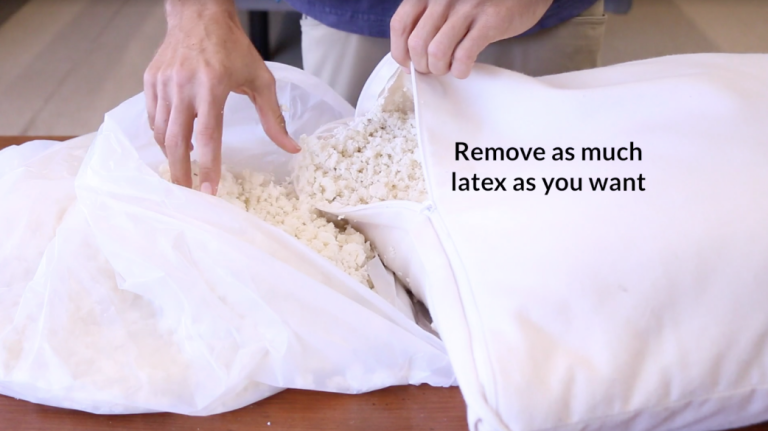
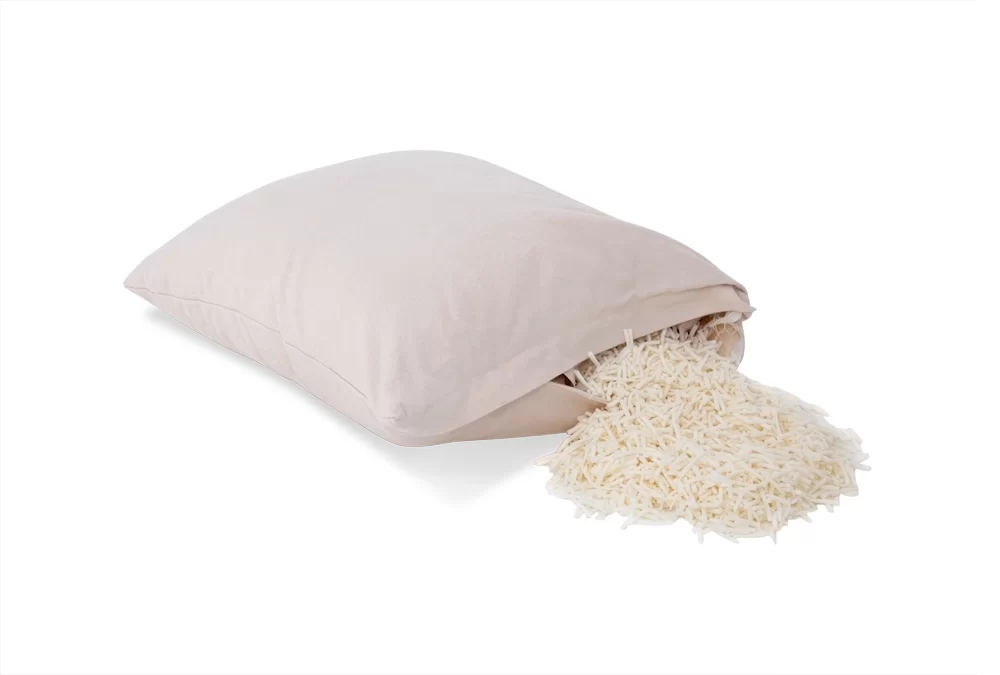
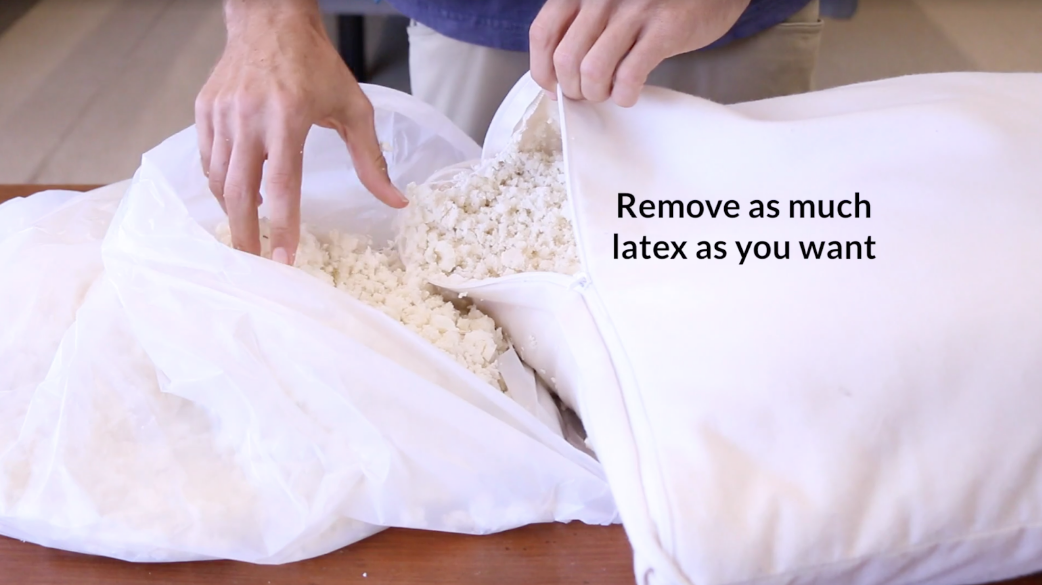
A shredded latex pillow is filled with small pieces of latex, sometimes curled noodles, sometimes irregular chunks, rather than a single molded core. The fill can be added or removed through a zippered opening, making loft adjustment straightforward. If the pillow feels too high after a week, you take some fill out. If it settles and feels too low, you add fill back in.
Shredded fill is also more conforming than a solid core. The individual pieces shift and rearrange as you move, which means the pillow cradles different head positions naturally rather than holding a fixed shape. This makes shredded latex pillows particularly well suited for combination sleepers who shift between side and back positions through the night.
The Sleeping Organic shredded latex pillow is filled with shredded Dunlop latex and covered in organic cotton. It’s our most popular pillow because of how customizable it is, most sleepers find their ideal loft within the first week.
A solid latex pillow is molded from a single piece of latex. There’s no adjustment mechanism, the loft and firmness are fixed by how the pillow was made. What solid pillows offer in return is consistent, even support across the entire surface. There are no voids or soft spots, and the head doesn’t sink through to one side of a fill pocket.
Solid pillows tend to run lower in loft than shredded options, and they hold their shape precisely night after night. They’re the preferred choice for back sleepers who need gentle, predictable neck support at a consistent height, and for anyone who sleeps with a pillow between their knees, where consistent shape matters more than adjustability.
Both Dunlop and Talalay latex come from natural rubber, but the manufacturing processes produce meaningfully different materials. Understanding the difference helps you choose the right pillow for your needs. For a deeper breakdown, see our full guide on Dunlop vs. Talalay latex.
Dunlop latex is produced by pouring whipped latex into a mold and baking it. The result is a denser, heavier material with a supportive, grounded feel. Dunlop tends to be slightly firmer at the same ILD rating as Talalay, and it’s more durable over time. In pillow fill, shredded Dunlop provides solid support without feeling overly stiff.
Talalay latex is made using an additional vacuum and flash-freeze step that aerates the cell structure more evenly. The result is a lighter, softer, springier material with more point-elasticity, it conforms closely to curved shapes. In pillows, Talalay fill produces a noticeably more luxurious, cloud-like feel. Talalay noodle pillows are the softest option in the Sleeping Organic lineup.
| Pillow Type | Fill | Feel | Loft | Best For |
|---|---|---|---|---|
| Shredded Dunlop | Shredded Dunlop latex chunks | Supportive, responsive | Adjustable (medium–high) | Side sleepers, combination sleepers |
| Solid Dunlop | One-piece molded Dunlop core | Firm, even, consistent | Fixed (medium–low) | Back sleepers, between-knees use |
| Shredded Talalay Noodle | Talalay latex noodles | Soft, plush, luxurious | Adjustable (medium) | Back sleepers, sensitive necks |
| Solid Talalay | One-piece molded Talalay core | Soft, springy, consistent | Fixed (low–medium) | Back sleepers, between-legs pillow |
Pillow selection is not one-size-fits-all. The ideal pillow fills the gap between your head and the mattress while keeping your cervical spine in neutral alignment. That gap varies significantly by sleep position.
Side sleeping creates the largest gap between head and mattress, the distance from your shoulder to your ear. A pillow that’s too thin leaves the neck unsupported and tilted downward. A pillow that’s too soft compresses under your head’s weight and has the same effect.
Side sleepers need a pillow with enough loft to fill the shoulder gap, and enough firmness to stay there under compression. The shredded Dunlop latex pillow is the best match: start with a full fill and gradually remove material until your neck and spine feel aligned. Most side sleepers find their ideal height with roughly 80–90% of the original fill.
Shoulder width matters too. Broader-shouldered sleepers need more loft; narrower-shouldered sleepers need less. Adjustability is the single most valuable feature for side sleepers, which is why a shredded pillow consistently outperforms a fixed solid pillow for this position.
If you’re also looking for a mattress optimized for side sleeping, see our guide on the best latex mattress for side sleepers.
Back sleepers need far less loft than side sleepers. The head lies closer to the mattress surface, and the pillow’s job is to maintain the natural inward curve of the cervical spine, not to fill a wide gap. A pillow that’s too high pushes the chin toward the chest, straining the posterior neck. A pillow that’s too flat provides no support for the cervical curve at all.
Both the shredded Talalay noodle pillow (with fill removed to reduce loft) and the solid Dunlop pillow work well for back sleepers. The shredded Talalay offers a softer, more conforming feel. The solid Dunlop provides more structured, even support. Back sleepers who tend to move around during the night typically prefer the shredded fill for its adaptability.
For mattress guidance to pair with your pillow choice, see our post on the best latex mattresses for back sleepers.
Stomach sleeping is hard on the cervical spine under the best of conditions. The head is rotated 90 degrees for hours at a time, and any significant pillow height under the head exaggerates the strain. Stomach sleepers who use a pillow should use the thinnest option available, or no head pillow at all.
For stomach sleepers who do want a pillow, the solid Talalay or solid Dunlop at low loft are the most reasonable choices. The consistent, flat surface prevents pressure from concentrating in one area of the neck. Many stomach sleepers find that placing a thin pillow under the pelvis rather than the head reduces lumbar strain more effectively than any pillow configuration under the head.
For mattress considerations specific to stomach sleeping, see our guide on the best latex mattresses for stomach sleepers.
Combination sleepers shift positions throughout the night, which means their pillow needs to work reasonably well in multiple orientations. No fixed-loft pillow can do this well. The shredded latex pillow, either Dunlop or Talalay, is the only real option for combination sleepers because the fill redistributes as you move. Set the loft for your primary position, and the pillow will adapt well enough to secondary positions without forcing a compromise that suits neither.
Memory foam is widely marketed as a premium sleep material, but it has specific limitations that matter significantly in a pillow application.
The latex is only part of a pillow. Check the cover fabric, whether it is removable, and its care instructions. Material claims should be specific to the pillow you are buying.
For the latex fill itself, look for GOLS (Global Organic Latex Standard) certification, which verifies that the latex comes from certified organic rubber tree plantations. Oeko-Tex Standard 100 certification independently tests finished products for harmful substances. It’s a meaningful secondary certification even for products that aren’t organically sourced.
Sleeping Organic pillows use GOLS-certified organic latex fill and organic cotton covers.
A pillow can only do so much. If the mattress isn’t supporting the spine correctly, no pillow thickness will compensate. The spine’s alignment starts at the hips and lumbar region, the mattress controls that, and extends up through the thoracic and cervical spine, where the pillow takes over. When the mattress is right for your body and sleep position, the pillow choice becomes simpler because you’re adjusting the last few inches of alignment, not compensating for a deeper problem.
If you’re building a complete sleep system, the natural latex mattress allows you to configure each layer independently, firmness, thickness, and latex type, for your exact body weight and sleep position. Pair it with a matching organic mattress foundation for full support from base to surface.
For mattress guidance around back pain specifically, see our post on latex mattresses and back pain.
A quality natural latex pillow typically lasts 5 to 10 years with regular use, compared to 1 to 3 years for polyester fill and 3 to 5 years for most memory foam. Latex holds its original shape and support level far longer than other materials because it’s elastic rather than viscoelastic, it returns fully after each compression rather than gradually deforming over time. Washing the cover regularly and fluffing the fill periodically will extend the pillow’s life further.
Yes, when properly fitted to the sleeper’s position and shoulder width. The most common cause of pillow-related neck pain is incorrect loft, a pillow that holds the head too high or too low. Latex pillows, particularly shredded fill models, are easier to dial in to the correct height than fixed-loft foam pillows. Once loft is correct, latex’s consistent support (no sagging, no permanent compression) maintains proper alignment through the night. For neck pain related to mattress support, the underlying mattress firmness should be evaluated as well.
Natural latex is significantly cooler than memory foam. The open-cell structure of latex, particularly Talalay, which has a more uniform open-cell construction, allows air to circulate continuously through the fill. Shredded latex pillows run especially cool because air moves freely between fill pieces rather than through a solid core. Most sleepers who switched from memory foam to latex report an immediate and noticeable improvement in temperature regulation.
The latex fill itself should not go in a washing machine, agitation and soaking can break down the material. Spot-clean the fill if needed with mild soap and water, and allow it to dry fully before re-covering. The cotton cover, however, can and should be machine washed regularly. Most Sleeping Organic pillows come with a zippered cover that removes easily for washing. Washing the cover every 2 to 4 weeks is sufficient for most sleepers.
For shoulder pain specifically, the critical variable is loft and the ability to adjust it. Shoulder pain during sleep is almost always caused by one of two problems: a pillow that’s too high (pushing the head up and compressing the shoulder), or a pillow that’s too low (causing the head to drop and pulling on the shoulder). Shredded latex pillows can be adjusted incrementally until neither problem exists. Solid pillows offer no adjustment, if the fixed loft isn’t the right height for your shoulder width, you’ll compensate with position instead of pillow height, which typically makes shoulder pain worse.
Most latex allergies are contact allergies triggered by direct skin exposure to latex proteins. A pillow covered in organic cotton presents minimal direct contact between skin and the latex fill. That said, anyone with a confirmed latex allergy, particularly a severe or systemic reaction, should consult with a medical professional before using any latex-containing bedding product. Talalay latex, due to its wash cycle during production, tends to have lower protein levels than Dunlop latex, which is sometimes cited in discussions of latex sensitivity, but this is not a medical recommendation. When in doubt, ask your allergist.
Both are adjustable, both breathe well, and both outlast synthetic alternatives significantly. The difference is feel. Shredded Dunlop is firmer and more supportive, it provides a grounded, structured feel under the head. Shredded Talalay is softer and springier, it cradles more, pushes back less firmly, and has a distinctly more luxurious feel. Side sleepers who need reliable neck support typically prefer shredded Dunlop. Back sleepers and those who want a softer, more contouring pillow tend to prefer shredded Talalay. If you’re uncertain, the shredded Dunlop pillow is the more versatile starting point, it works well across more sleep positions and body types.
Looking for a natural latex pillow?
Our 100% natural shredded latex pillow features adjustable fill, an organic cotton cover, and is handcrafted in the USA.