Have a saved cart?
Enter your email to restore it.

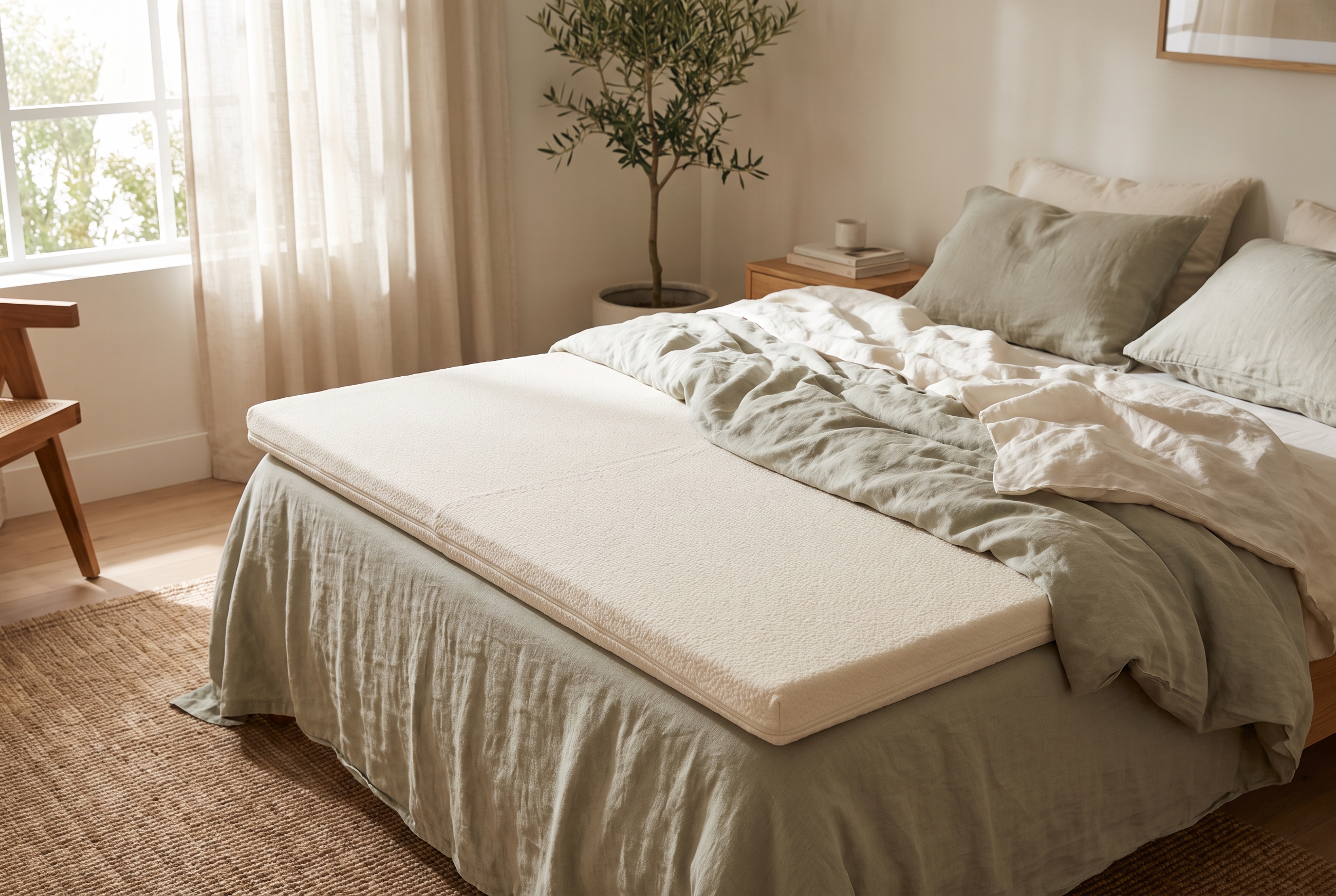
You wake up with a stiff lower back. By the time you’ve had coffee, it eases, but the pattern repeats night after night. Your mattress is probably part of the problem, but replacing it isn’t always practical or affordable.
A mattress topper is one of the more sensible middle steps, and yes, a latex topper can relieve back pain when the cause is a sleep surface that’s too firm, too soft, or worn on top; it can’t fix a mattress whose support core is sagging. Among topper materials, latex has a real case to make for people with back pain. It isn’t the right answer for everyone, though, and thickness, firmness, and sleeping position all matter more than most product pages let on.
This guide walks through what the research says about mattresses, toppers, and back pain, and how to decide whether a latex topper is the right fit for your situation.
Sleep-related back pain generally comes from one of three sources: an underlying medical condition, your sleeping position, or a mattress that’s no longer doing its job. A topper can only help with the last two. It won’t resolve a disc issue or muscle injury, but it can change how your body is supported through the night.
The mechanism is straightforward. When a mattress is too firm, it creates pressure points at the shoulders and hips. When it’s too soft, heavier body parts sink and pull the spine out of alignment. Either scenario forces surrounding muscles to work through the night to stabilize the spine, and you wake up sore.
A well-chosen topper can correct both problems by adding a contouring layer that redistributes pressure and restores neutral spinal alignment.
The most-cited study on mattress firmness and back pain is a 2003 randomized controlled trial published in The Lancet. Researchers followed 313 adults with chronic non-specific low back pain for 90 days and found that patients sleeping on medium-firm mattresses reported better outcomes than those on firm mattresses across three measures: pain in bed, pain on rising, and daytime disability.
A later systematic review of 24 controlled trials found that medium-firm mattresses can improve sleep quality by 55% and reduce back pain by 48% in patients with chronic low back pain. Population data lines up with this: one large sample found low back pain prevalence of about 61% among soft mattress users, versus roughly 38% among firm mattress users. The sweet spot, consistently, is in the middle.
The old advice to “sleep on a hard surface” for back pain is outdated. What works instead is a surface firm enough to keep the spine neutral, but forgiving enough to relieve pressure at the shoulders and hips. On a 10-point firmness scale, that’s roughly a 5 to 6.
Latex has a few properties that make it well-suited for back pain relief, and they come from the material itself, not from marketing.
Latex is buoyant and responsive. It compresses under pressure points but pushes back quickly, which keeps you from sinking into a fixed position the way you can on memory foam. A 2017 study by Son et al. found that latex distributes body pressure more evenly than polyurethane foams, reducing peak pressure at the shoulders and hips. A 2021 study in the Journal of Chiropractic Medicine reported that latex toppers improved spinal alignment and reduced motion transfer compared to polyurethane alternatives.
Both types of natural latex can work for back pain. The difference is feel. Dunlop is denser and more supportive, making it a better choice if your existing mattress is too soft and you need to add structure. Talalay is lighter and more cushioning, better if your mattress is too firm and you need more pressure relief. Neither is inherently better; the right choice depends on what your current sleep surface is doing wrong.
Latex has an open-cell structure that allows air to move through it. Unlike memory foam, which tends to trap heat as it conforms, latex sleeps cool. That matters for back pain indirectly: overheating disrupts sleep, and disrupted sleep tends to amplify pain sensitivity the next day.
High-quality natural latex toppers commonly last 8 to 10 years, and some sources put the upper end at 15 years. Memory foam toppers typically need replacing around the 5-year mark. If you’re spending money to solve a persistent problem, the material that holds its properties longest is usually the better investment. Our Natural Latex Topper is built with this longevity in mind.
Thickness is where most people go wrong. Too thin, and the topper doesn’t change the feel of your mattress much. Too thick, and it can allow heavier body parts to sink too far, undoing the alignment benefit.
The Sleep Foundation recommends a minimum of 2 inches for back pain relief. For spinal alignment specifically, 2 to 3 inches is generally the ideal range. From there, your sleeping position refines the choice:
Heavier sleepers and those with more severe back pain often benefit from the thicker end of the range for their position, because they compress the topper more and need additional material to reach the sweet spot.
Given what the research shows about medium-firm mattresses, a medium-firm topper, roughly 5 to 6 on a 10-point scale, is generally the best starting point for back pain. It’s forgiving enough to contour to your body but supportive enough to keep the spine neutral.
There’s an important caveat: the topper’s firmness combines with your mattress’s firmness. If your current mattress is too soft, a firmer topper can restore support. If your mattress is too firm, a softer topper can add the cushioning that’s missing. The goal is that the combined surface behaves as medium-firm, not that the topper itself does.
If you’re adding a topper specifically to sleep better, it’s worth paying attention to what you’re breathing in for the next decade. Not all latex is created equal. Blended and synthetic latex products can contain petroleum-based fillers and chemical additives that off-gas over time.
GOLS (Global Organic Latex Standard) is the internationally recognized certification for organic latex foam. GOLS-certified latex must contain at least 95% organic latex and meet strict standards across the entire supply chain, from the rubber tree plantations through manufacturing, covering environmental impact, social responsibility, and emissions. GOLS-certified latex is produced without synthetic rubber or harsh chemical additives, and it’s naturally low in VOCs, meaning less off-gassing in your bedroom.
Natural latex itself is also inherently resistant to dust mites, mold, and mildew, a material property rather than a chemical treatment. That’s a real benefit if allergies or respiratory issues also contribute to your poor sleep. (Note: people with a diagnosed latex allergy should avoid latex products entirely.)
You can read more about how we source and build our latex products on our process page.
A topper is a real solution when your mattress is fundamentally sound but not quite right: too firm, too soft, or missing enough contouring at the shoulders and hips. It can also buy time when replacing a mattress isn’t practical.
It’s not a fix for a mattress that’s visibly sagging or has developed body impressions. Once the underlying support structure has broken down, adding a layer on top just replicates the failure at a higher elevation. If your mattress is more than 8 to 10 years old and showing wear, a topper is a stopgap at best.
In that case, the more durable solution is a new mattress built on latex from the ground up. Our Natural Latex Mattress is customizable by firmness layer, which lets you dial in the exact support profile your back needs. Paired with a proper mattress foundation, it addresses the root cause instead of masking it.
Back pain doesn’t resolve overnight, and neither does the adjustment to a new sleep surface. Most sleep researchers recommend 2 to 4 weeks to evaluate a topper honestly. Your body needs time to adapt to new alignment, and pain that’s been building for months won’t disappear in a night or two.
Track how you feel on waking, not just how the bed feels when you lie down. The topper is doing its job if pain on rising decreases over the first few weeks, even if the immediate sensation of the bed feels different from what you’re used to.