Have a saved cart?
Enter your email to restore it.

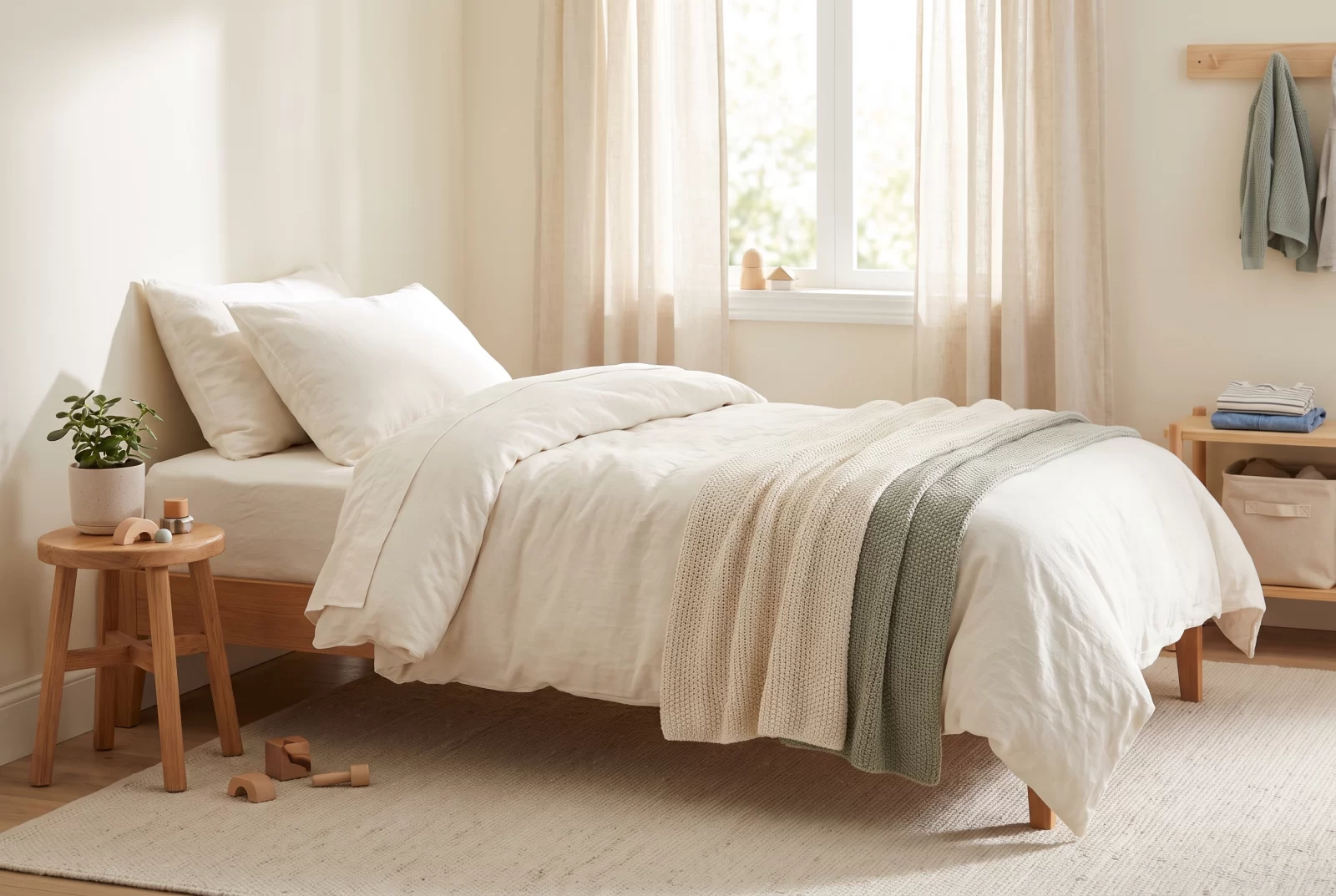
A twin mattress is often the first mattress a person owns, bought for a child, a bunk bed, a guest room, or a small apartment. A standard twin measures 38 inches wide by 75 inches long, and a twin XL adds five inches of length at 38 by 80. Because the footprint is small and the price is usually lower than a queen or king, it’s easy to treat the decision as low-stakes.
It isn’t. A twin is where kids spend a third of their childhood. It’s where a guest forms an opinion of your home. It’s where a college student sleeps for four years. The material inside that mattress matters as much as in any other size, arguably more.
This guide walks through twin dimensions, when a twin makes sense, and what to look for in a natural latex build that will last.
A standard twin measures 38 inches wide by 75 inches long (96.5 × 190.5 cm). It’s the smallest standard mattress size in the United States. A twin XL is the same 38-inch width but adds five inches of length, coming in at 38 × 80 inches. Twin XL is the standard for most college dorms and works better for anyone approaching six feet tall.
The minimum recommended room size for a twin bed is about 7 × 10 feet, which leaves usable floor space around the frame. That makes twin the practical choice for:
Twin is not practical for adults over 5’10”, and it won’t comfortably accommodate two sleepers. If a growing teenager is likely to pass six feet, twin XL is the safer buy.
Bunk beds have specific requirements. The mattress should be 8 inches thick or less to maintain safe guardrail clearance. The guardrails on a top bunk are engineered around a thin mattress profile, so a taller mattress reduces the effective height of the rail and creates a fall risk.
You’ll also want at least 33 to 38 inches of headroom above the top bunk mattress, which generally means an 8-foot ceiling minimum. And confirm the bunk frame holds the full 38 × 75 inches without gaps at the head, foot, or sides.
Twin mattresses often end up under the sleeper who is most vulnerable to what’s inside them: a child. Children breathe faster than adults relative to body size, spend more hours in bed, and have developing systems that are more sensitive to chemical exposure.
Conventional mattresses are typically built from polyurethane foam or synthetic memory foam. Both off-gas volatile organic compounds (VOCs). A 2019 American Chemical Society study found that mattresses can emit VOCs posing particular health risks to children. Synthetic memory foam is the worst off-gassing offender in the mattress industry, followed by polyurethane foam and synthetic latex.
100% natural latex mattresses have minimal to no off-gassing and do not release significant levels of VOCs. That’s the primary reason many parents choose latex for a child’s twin: not marketing, but material science.
A high-quality natural latex mattress can last 20 years or more. For comparison, memory foam typically lasts 7 to 10 years and innerspring mattresses 5 to 7 years. Latex mattresses often carry 20 to 25 year manufacturer warranties, reflecting that durability.
Practically speaking, this means a twin latex mattress bought when a child is five may still be usable when they leave for college. That reframes the cost calculation. A conventional foam twin replaced two or three times over the same span often ends up costing more, generates more landfill waste, and repeats the off-gassing exposure with each new mattress.
You can read more about how we build ours on our process page, and details on coverage are on our warranty page.
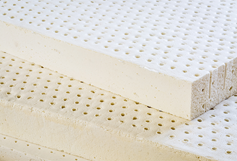
Natural latex is manufactured through one of two processes: Dunlop or Talalay. Both start with the sap of the rubber tree and both rely on vulcanization to cure the foam. The differences come from how the sap is processed.
The Dunlop process was first developed in 1929 and remains largely unchanged. It produces a denser, heavier foam. Dunlop is generally used as the support core of a mattress because of its density and structural stability.
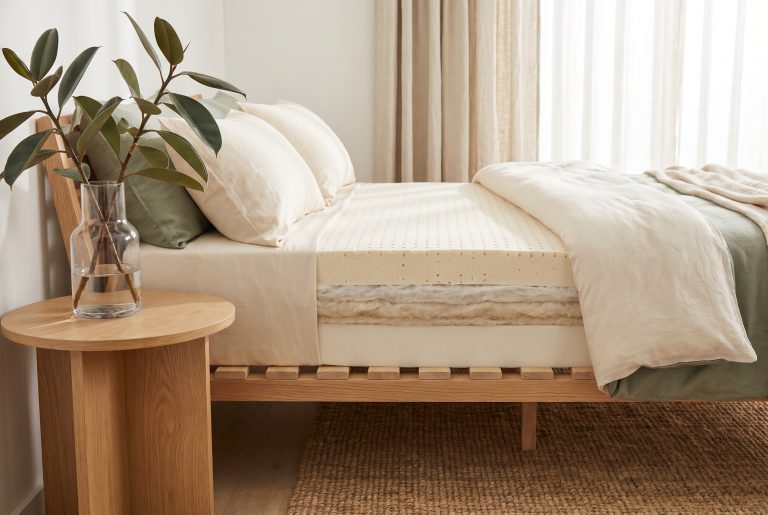
Talalay involves additional steps, vacuum sealing and flash-freezing, that create a less dense, more airy structure. It’s typically used as a comfort layer near the top of the mattress because of its lighter, bouncier feel.
A common myth is that Talalay is always softer than Dunlop. That’s not true. Both Dunlop and Talalay can be produced across a wide range of firmnesses. Dunlop’s higher density doesn’t automatically mean higher firmness. The firmness (measured in ILD, or Indentation Load Deflection) is set during manufacturing regardless of process.
For a twin, most well-built latex mattresses use a Dunlop core with either a Dunlop or Talalay comfort layer on top. Our Natural Latex Mattress is built this way and is available in a twin size with configurable firmness.
The word “latex” on a mattress label doesn’t tell you much on its own. There’s a large gap between 100% natural latex and blended or synthetic latex.
SBR (Styrene-Butadiene Rubber) is a petroleum-based synthetic often marketed as “latex.” It lacks the breathability, resilience, and durability of natural latex. Blended latex, a mix of natural and synthetic, typically lasts 6 to 10 years rather than 20+.
The certification that matters most for latex specifically is GOLS (Global Organic Latex Standard). To carry GOLS certification, latex must:
GOLS is the only internationally recognized certification specifically for organic latex foam. If a mattress claims organic latex but doesn’t carry GOLS, ask why.
Latex is dense. A queen latex mattress can weigh 150 pounds or more; even a twin is substantially heavier than a foam twin of the same size. That weight, combined with warranty terms, makes the foundation non-negotiable.
Latex requires a strong, closely-slatted foundation with slats no more than 3 inches apart. Wider gaps allow the latex to sag between slats over time, which can void the warranty and shorten the mattress’s usable life. A solid platform or plywood-topped foundation also works. Our mattress foundation is built to those specifications.
For bunk beds, verify the existing bunk frame meets the slat spacing requirement. Many bunk frames come with slats spaced too far apart for latex and will need a bunkie board or additional slats added.
A quality mattress protector extends the life of any mattress and is generally required to keep the warranty valid. It also helps with the practical realities of a kid’s bed: spills, accidents, and the occasional sick night. See our mattress protectors for options that don’t add plastic or synthetic membranes against the sleep surface.
Rotate a latex mattress head-to-foot every 3 to 6 months. This distributes wear evenly and helps prevent any early impressions from forming in high-use areas. Latex mattresses don’t need to be flipped, since the layers are engineered in a specific top-to-bottom order, but rotation is important.
Beyond off-gassing and durability, latex has some functional advantages worth naming plainly:
None of this makes latex the right answer for every buyer. But for a twin that will be slept on nightly for years, by someone whose body is still developing, the case for natural latex is stronger than in almost any other size.