Have a saved cart?
Enter your email to restore it.


Most mattress guides treat anyone over 200 pounds as a single category. That’s useless. A 210-pound side sleeper and a 320-pound back sleeper have fundamentally different support needs. The physics of how latex compresses under higher body weight changes everything: which firmness to choose, how many layers you need, and which latex type belongs where in the stack.
This guide gives you specific, weight-range configurations for finding the best latex mattress for heavy people. No vague advice. No one-size-fits-all recommendations.
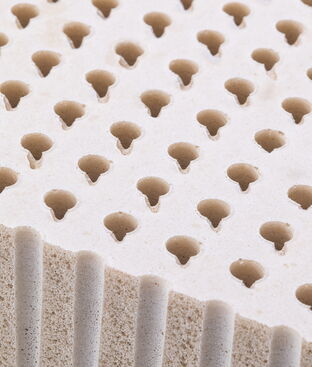
Latex compresses proportionally to the force applied to it. A 150-pound person on a medium-to-firm latex layer compresses it roughly 1.5 inches. A 280-pound person compresses that same layer over 3 inches. That’s not a small difference. It changes the entire feel of the mattress and, more importantly, whether your spine stays aligned.
At higher body weights, three things happen that standard advice doesn’t account for:
Understanding ILD firmness ratings is essential here because they directly predict how much a layer compresses under your specific weight.
The most common mistake heavy sleepers make is buying a firm, thin mattress. Firmness alone doesn’t solve the problem. Depth does.
A thin mattress forces all of your weight through fewer inches of material. No matter how firm those inches are, a heavier body will compress through them and hit the foundation. A deeper mattress distributes compression across more material, keeping you supported without that hard, bottomed-out feeling.
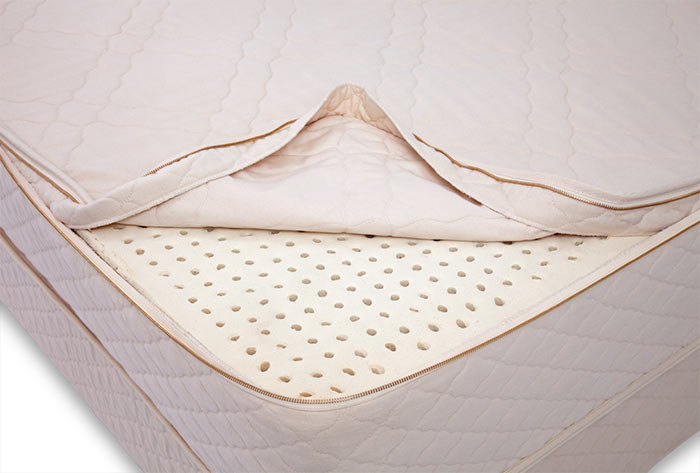
This is why a custom latex mattress with individually selected layers matters so much at higher weights. You’re not just picking a firmness level. You’re engineering a stack.
Our Natural Latex Mattress comes in three depths, and the right choice depends almost entirely on your body weight.
Two 3-inch latex layers plus a 3-inch wool and cotton quilted cover. At 200-250 pounds, this can work for back sleepers who choose firmer ILD values. Above 250 pounds, the Sapling doesn’t provide enough depth to prevent bottoming out in any sleep position.
Three 3-inch latex layers plus a 1-inch quilted cover. The extra layer gives you a dedicated comfort layer on top of two support layers. Viable for the 200-250 range in most sleep positions and potentially workable at 250-300 for back sleepers with firmer configurations.
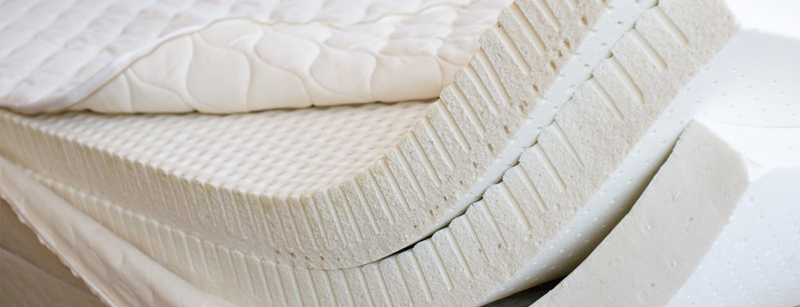
Four 3-inch latex layers plus a 1-inch quilted cover. This is the recommended configuration for anyone over 250 pounds and the only one we suggest for 300+ pounds. Four layers let you build a true zoned stack: soft comfort on top, graduated firmness through the middle, and a firm Dunlop base that won’t compress under heavy loads.
Nearly every heavy sleeper who contacts us initially picks firmness levels that are too soft. Here’s why: mattress showrooms calibrate “medium” to a 150-170 pound person. What feels medium to that person feels soft to someone at 260 pounds because they compress the material more deeply.
As a general rule above 200 pounds, move at least one current option firmer than your initial instinct. If you think Medium 30–32 sounds right, start with Firm 37–40; use X-Firm 44 for a lower support layer when needed.
The 365-day comfort exchange program means you can adjust if needed, but starting too soft is a more common problem than starting too firm.
The bottom layer of any mattress for a heavier sleeper must be Dunlop latex, not Talalay. This isn’t preference. It’s physics.
Dunlop latex is denser and firmer than Talalay at the same ILD rating. It resists deep compression better and maintains its support properties under sustained heavy loads. Talalay is lighter and more consistent in feel, which makes it excellent for comfort layers. But as a base layer under 250+ pounds, Talalay compresses too deeply and accelerates wear.
The differences between Dunlop and Talalay latex become much more significant at higher body weights. Both are excellent materials. They just belong in different positions in the stack.
A latex mattress on a weak foundation is a latex mattress that sags. At higher body weights, the foundation absorbs more force, and any flex or give in the support surface translates directly into reduced mattress performance.
Slatted bed frames with gaps wider than 3 inches allow latex to compress into the gaps under heavy weight, creating uneven support and accelerating wear. A solid-surface organic mattress foundation provides consistent, unyielding support across the entire mattress surface. At 250+ pounds. This is the single highest-impact upgrade beyond the mattress itself.
| Sleep Position | Recommended Model | Top Layer | Middle Layer(s) | Base Layer |
|---|---|---|---|---|
| Side | Sprout or Tree | Medium (30–32 ILD) | Medium or Firm (30–32 or 37–40 ILD) | Firm or X-Firm Dunlop (37–40 or 44 ILD) |
| Back | Sprout or Tree | Medium or Firm (30–32 or 37–40 ILD) | Firm (37–40 ILD) | X-Firm Dunlop (44 ILD) |
| Stomach | Sprout or Tree | Medium or Firm (30–32 or 37–40 ILD) | Firm or X-Firm (37–40 or 44 ILD) | X-Firm Dunlop (44 ILD) |
At this weight range, side sleepers should prioritize enough give in the top layer for shoulder and hip pressure relief. Back sleepers need a firmer surface to prevent excessive pelvic sinking.
| Sleep Position | Recommended Model | Top Layer | Upper-Mid Layer | Lower-Mid Layer | Base Layer |
|---|---|---|---|---|---|
| Side | Tree | Medium (30–32 ILD) | Medium or Firm (30–32 or 37–40 ILD) | Firm (37–40 ILD) | X-Firm Dunlop (44 ILD) |
| Back | Tree | Medium or Firm (30–32 or 37–40 ILD) | Firm (37–40 ILD) | X-Firm (44 ILD) | X-Firm Dunlop (44 ILD) |
| Stomach | Tree | Firm (37–40 ILD) | X-Firm (44 ILD) | X-Firm (44 ILD) | X-Firm Dunlop (44 ILD) |
The Tree’s 4-layer design is strongly recommended starting at 250 pounds. The graduated firmness profile prevents bottoming out while still allowing the top layer to provide pressure relief.
| Sleep Position | Recommended Model | Top Layer | Upper-Mid Layer | Lower-Mid Layer | Base Layer |
|---|---|---|---|---|---|
| Side | Tree | Medium or Firm (30–32 or 37–40 ILD) | Firm (37–40 ILD) | X-Firm (44 ILD) | X-Firm Dunlop (44 ILD) |
| Back | Tree | Firm (37–40 ILD) | X-Firm (44 ILD) | X-Firm (44 ILD) | X-Firm Dunlop (44 ILD) |
| Stomach | Tree | X-Firm (44 ILD) | X-Firm (44 ILD) | X-Firm (44 ILD) | X-Firm Dunlop (44 ILD) |
Above 300 pounds, the Tree is the only appropriate model. Every firmness level shifts upward, but notice the top layer still isn’t the firmest option for side sleepers. Even at this weight, you need some pressure relief at the shoulders and hips. The depth of the mattress provides the support. The top layer provides the comfort.
When partners differ by 50+ pounds, a single firmness configuration can’t serve both people well. Split firmness solves this. Each side of the mattress gets its own layer configuration matched to that sleeper’s weight and position.
With a custom latex mattress, split firmness doesn’t require buying two separate mattresses. Each layer is simply configured differently on each half. The shared organic cover keeps everything together as one mattress. This is especially valuable when one partner falls in the 150-180 range and the other is 250+. Those two people need fundamentally different support, and split firmness delivers it without compromise.
Selecting the right configuration from a guide is a strong starting point, but bodies are variable. Our 365-day comfort exchange program lets you swap individual layers if your initial configuration doesn’t feel right. This matters more for heavier sleepers because the margin between “supportive” and “too firm” narrows at higher weights.
If you start with the configurations above and find the top layer too firm after the break-in period, you can exchange just that layer for a softer ILD. You don’t replace the entire mattress. This layer-by-layer adjustability is one of the core advantages of a modular latex mattress design, particularly for heavier sleepers who are harder to fit on the first try.
Memory foam softens with body heat, which creates a compounding problem at higher weights. More weight means more heat means softer foam means deeper sinking. The result is a mattress that feels fine for the first year and then sags permanently where the heaviest parts of your body rest.
Innerspring mattresses concentrate force on individual coils. At higher body weights, the coils under the hips take disproportionate load and wear out faster, creating a body impression.
Natural latex is resilient. It compresses under load and returns to its original shape when the load is removed. It doesn’t soften with heat. It doesn’t take permanent impressions. A properly configured latex mattress supports a 300-pound sleeper on day one identically to day 3,000. If back pain is a factor, latex’s consistent support is particularly beneficial at higher weights.
At 250+ pounds, a 13-inch mattress with 4 latex layers (the Tree model) provides the depth needed to prevent bottoming out. The 10-inch Sprout can work for some back sleepers in the 250-280 range with firm configurations, but the Tree is the safer choice. At 300+, the Tree is the only model we recommend.
Both. Talalay works well for top comfort layers where you want consistent pressure relief. Dunlop is essential for the base layer (and often the lower-middle layers) because of its higher density and resistance to deep compression. At higher weights, always use Dunlop for at least the bottom two layers.
Natural latex is one of the most durable mattress materials available. With proper configuration and a solid foundation, a latex mattress won’t develop permanent body impressions regardless of your weight. This is a significant advantage over memory foam and innerspring, both of which sag faster under heavier loads.
Yes. A solid-surface foundation is strongly recommended at 250+ pounds. Slatted frames allow the mattress to compress into gaps between slats, creating uneven support and accelerating material fatigue. A proper foundation makes a measurable difference in how a latex mattress performs and how long it lasts.
Natural latex has a break-in period of 2-4 weeks during which it softens slightly. If the mattress still feels too firm after this period, the 365-day comfort exchange program lets you swap individual layers for softer ILD values. You don’t need to replace the whole mattress.
Yes. Split firmness configurations give each side of the mattress its own layer setup. A 140-pound partner can have medium layers on their side while a 280-pound partner has firm layers on theirs. The shared organic cover maintains a seamless sleeping surface. This is one of the biggest advantages of a custom modular design.
Ready to try a natural latex topper?
Choose from 5 firmness levels in Talalay, Dunlop, or GOLS-certified organic, starting at $201.