Shopping for an organic mattress means encountering terms you won’t find at a conventional mattress store. This organic mattress bedding glossary breaks down every term you need to know, from fiber types to certifications, so you can make confident decisions about your sleep setup.
Bedding and Mattress Terms: A-F
Bed Frame
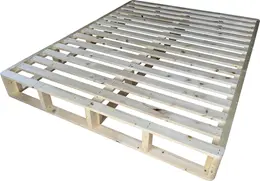
The support structure that holds your mattress and foundation off the ground. For organic mattresses, a slatted bed frame or platform bed works best. Slats should be no more than 3 inches apart.
Botanical Latex
Another term for natural latex derived from the sap of rubber trees (Hevea brasiliensis). Botanical latex contains no synthetic fillers or petroleum-based additives.
Box Spring
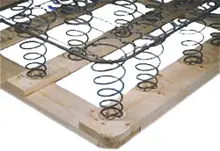
A traditional support base with an internal spring system. Most organic latex mattresses do not require a box spring and actually perform better on a solid foundation or platform.
Breathability
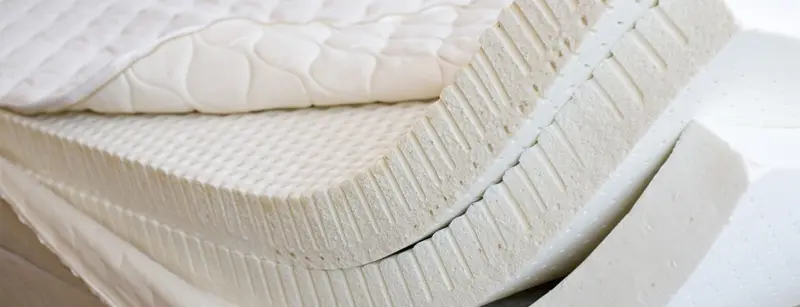
A material’s ability to allow air to circulate. Natural latex has an open-cell structure that promotes airflow, making it more breathable than memory foam or polyurethane.
Carding
The process of separating and aligning fibers, such as organic wool or cotton, before they are layered into batting for mattress covers and toppers.
Certified Organic
A claim supported by an independent standard and documentation for a specified material or product. For organic latex, look for the applicable GOLS supplier document. See our materials and certifications page.
Comfort Layer
The top layer of a mattress that provides pressure relief and contouring. In a natural latex mattress, the comfort layer is typically a softer layer such as X-Soft Talalay 14–19 or Soft 19–22 latex.
Cotton (Organic)
Cotton grown under organic agricultural practices. Cotton fabric is used in mattress covers, sheets, and pillow casings; check the specification of the particular product.
Dunlop Latex
A manufacturing process where liquid latex is poured into a mold, vulcanized, and baked in one continuous pour. Dunlop latex tends to be denser and more durable than Talalay.
Dust Mite Resistant
A material property that naturally discourages dust mite colonization. Natural latex is inherently dust mite resistant due to its dense structure and antimicrobial properties.
Foundation
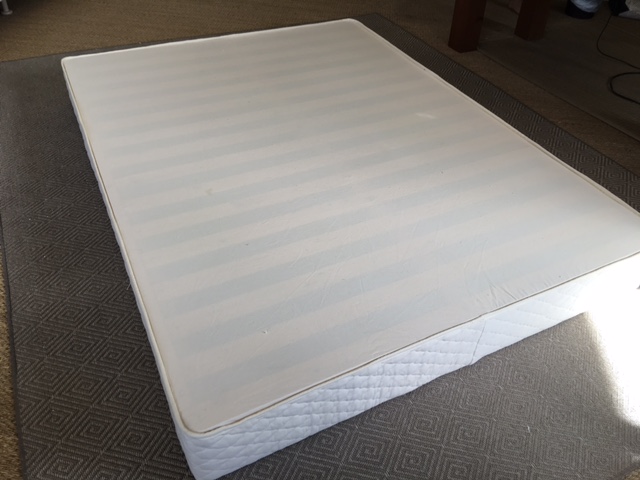
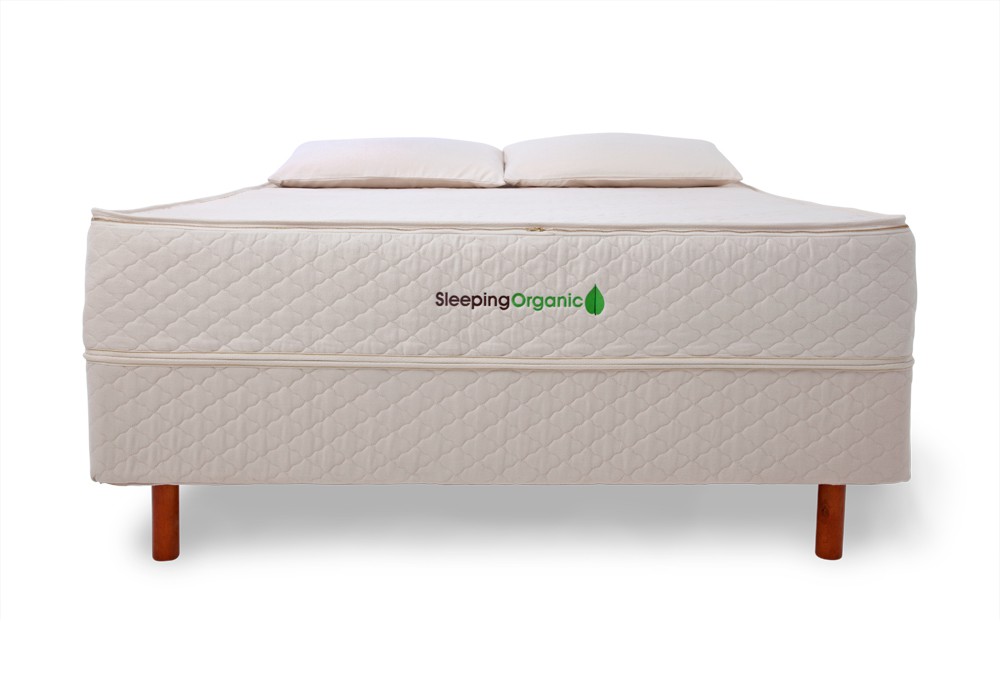
A flat, solid support base for your mattress. An organic mattress foundation provides even weight distribution without the bounce of a box spring.
Bedding and Mattress Terms: G-L
GOLS (Global Organic Latex Standard)
The leading international certification for organic latex. GOLS-certified latex must contain at least 95% certified organic raw material.
Hypoallergenic
A material less likely to cause allergic reactions. Natural latex, organic wool, and organic cotton are all naturally hypoallergenic.
ILD (Impression Load Deflection)
The standard measurement of latex firmness. A lower ILD (14–19) means softer; a higher ILD (37–40 or 44) means firmer. Most sleepers prefer a comfort layer between 30–32 ILD.
Innerspring
A mattress construction using metal coil springs as the primary support. Some hybrid organic mattresses combine innersprings with natural latex comfort layers.
Latex Allergy
A sensitivity to proteins found in raw latex sap. The vulcanization process used in mattress manufacturing removes virtually all allergenic proteins, making finished latex mattresses safe for most people with latex sensitivities.
A separate layer (typically 2-3 inches) placed on top of an existing mattress to adjust comfort. Natural latex toppers can soften a firm mattress or extend the life of an aging one.
Memory Foam
A petroleum-based polyurethane foam that conforms to body shape under heat and pressure. Unlike natural latex, memory foam traps heat and can off-gas volatile organic compounds (VOCs).
Off-Gassing
The release of volatile organic compounds (VOCs) from synthetic materials. Conventional mattresses can off-gas for weeks or months. Certified organic latex mattresses produce no harmful off-gassing.
Organic Wool
Wool from sheep raised on certified organic pastures without synthetic chemicals. In mattresses, organic wool serves as a natural fire barrier and moisture regulator.
Pincore Holes
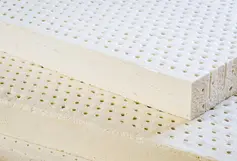
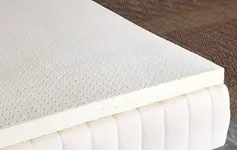
The small holes molded into latex during manufacturing. These holes improve airflow, regulate temperature, and can be varied in size and spacing to create different firmness zones.
Platform Bed
A bed frame with a solid or closely slatted surface that supports a mattress without requiring a box spring or foundation.
Polyurethane Foam
A petroleum-based foam used in most conventional mattresses. Contains chemical additives and is far less durable than natural latex.
Bedding and Mattress Terms: S-Z
Shredded Latex
Natural latex that has been shredded into small pieces, commonly used as pillow fill. A shredded latex pillow is adjustable since you can add or remove fill to change the loft.
Support Core
The bottom layer of a mattress that provides structural support and spinal alignment. In a latex mattress. This is typically a firmer ILD layer (30–32, 37–40, or 44 ILD).
Talalay Latex
A manufacturing process where liquid latex is poured into a mold, vacuum-sealed to distribute evenly, flash-frozen, and then baked. Talalay produces a more consistent, slightly bouncier feel than Dunlop.
VOCs (Volatile Organic Compounds)
Chemical compounds that evaporate at room temperature and can cause respiratory irritation, headaches, and other health effects. Found in synthetic mattresses, adhesives, and flame retardants.
Vulcanization
The heating process that transforms liquid latex into a solid, resilient foam. This process also removes the proteins responsible for most latex allergies.
Wool Batting
Layers of carded wool used inside mattress covers as padding, fire protection, and moisture management. Organic wool batting replaces synthetic fire retardant chemicals.
Zone Support
A mattress design with different firmness levels in specific body zones (shoulders, hips, lumbar) to optimize spinal alignment and pressure relief.
What does “certified organic” actually mean for a mattress?
Certification applies to the material or product named in its documentation. GOLS concerns organic latex. A certificate for a latex component does not certify the cover, wool, or assembled mattress.
What is the difference between ILD and density in latex?
ILD measures firmness (how much force it takes to compress the latex), while density measures weight per cubic foot. A latex layer can be high-density but low-ILD, meaning it is heavy and durable but soft to the touch. Both matter for comfort and longevity.
Is natural latex the same as organic latex?
No. Natural latex comes from rubber tree sap without synthetic fillers, but the trees may not be organically farmed. Organic latex meets all natural latex criteria plus the rubber trees are certified organic, meaning no chemical fertilizers or pesticides were used.
What does “hypoallergenic” mean in bedding?
Hypoallergenic means a material is unlikely to trigger allergic reactions. Natural latex, organic cotton, and organic wool are all naturally resistant to dust mites, mold, and mildew, the three most common bedroom allergens.
Why do organic mattresses use wool instead of chemical fire retardants?
Wool is a natural flame barrier that self-extinguishes when a flame source is removed. It meets federal flammability standards (16 CFR 1633) without any synthetic chemicals, making it the safest option for people who want to avoid exposure to chemical fire retardants.