Have a saved cart?
Enter your email to restore it.

Mattress adhesives are one of the most overlooked sources of chemical exposure in your bedroom. Every conventional mattress, whether memory foam, hybrid, or innerspring, uses glues to bond its layers together. These adhesives can release volatile organic compounds (VOCs) into the air you breathe while you sleep. A non-glued latex mattress eliminates this problem entirely by using unattached, interchangeable layers that require no adhesive whatsoever. In this guide, we explain the types of glues used in mattress manufacturing, why they matter for your health, and why a natural latex mattress with non-glued layers is the cleanest option available.
Three primary types of adhesives are used across the mattress industry. Each serves a different purpose and carries different health and environmental implications.
Solvent-based adhesives are the traditional choice in mattress production due to their strong bonding capability. They are applied through spraying, roll coating, or dotting to connect foam layers, fabrics, and coil units. The significant drawback is that as these adhesives dry, the solvents evaporate and release fumes that degrade indoor air quality. These fumes contain VOCs that are linked to respiratory irritation, headaches, and long-term health concerns.
Waterborne adhesives use water as the solvent instead of chemicals, making them a more eco-friendly alternative. They emit no harmful VOCs and are odorless once dry. However, their bonding strength is lower than solvent-based options, and they require longer drying times. If not properly managed during manufacturing, the extended drying period can trap moisture inside the mattress, creating conditions for mold growth.
Hot melt adhesives represent the newest approach in mattress manufacturing. Applied in a heated liquid state, they solidify quickly upon cooling and create a strong bond without any solvent evaporation. This means no VOC emissions during or after production. Hot melt adhesives are the least harmful option among conventional mattress glues, though some sleepers report a cracking noise from these adhesives as they settle.
While hot melt adhesives are an improvement over solvent-based glues, the best option is no adhesive at all. A non-glued latex mattress provides several advantages that glued mattresses simply cannot match.
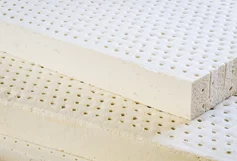
When no adhesive is used, there are zero VOC emissions from bonding agents. Combined with 100% natural latex, organic cotton, and organic wool, a non-glued latex mattress creates the cleanest possible sleeping environment. This matters especially for people with allergies or chemical sensitivities.
Because the latex layers are not bonded together, you can rearrange, swap, or replace individual layers at any time. If your mattress feels too firm after a few months, you can exchange a layer for a softer one without replacing the entire mattress. This customizable design means your mattress adapts to your changing needs over the years.
With a glued mattress, if one layer wears out, you replace the entire mattress. With a non-glued design, you replace only the worn layer. This can extend the functional life of your mattress to 25 years or more, since the durable support core rarely needs replacement.
Eliminating adhesives removes one of the primary sources of off-gassing in mattresses. Many people who switch from memory foam or hybrid mattresses to a non-glued latex mattress report noticeably cleaner air in their bedrooms and fewer morning headaches.

There is one important exception to the no-glue rule in latex mattresses. The natural latex used in mattresses is harvested and poured on rubber plantations in Sri Lanka and southern India. The molds used on these plantations come in only two sizes: King and Queen.
Because no California King molds exist, manufacturers must cut a King-size piece of latex to the narrower California King width and then attach the cut portion to the bottom to achieve the longer California King length. This process requires adhesive.
At Sleeping Organic, we use the cleanest, safest adhesive available for our California King latex mattresses. Every other mattress size, including King, Queen, Full, and Twin, uses completely non-glued layers.
To understand why adhesive-free construction matters, consider what goes into a typical non-latex mattress:
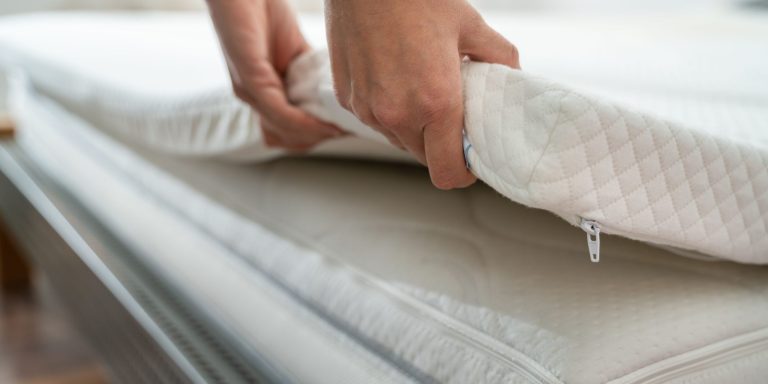
A common question about non-glued mattresses is whether the layers shift during sleep. The answer is no. Natural latex layers are dense and heavy, which means they naturally resist movement. Additionally, the custom latex mattress uses a fitted zip-off organic cotton cover that holds all layers snugly in position. The combination of latex weight and a properly fitted cover eliminates any shifting or sliding.
No. Many latex mattress manufacturers glue their layers together during production. Look specifically for mattresses with non-glued, interchangeable layers inside a zip-off cover. California King sizes will require some adhesive due to mold size limitations at rubber plantations.
Sleeping Organic uses a non-toxic, low-VOC hot melt adhesive for California King latex layers. This is the safest adhesive option available and is only used because California King molds do not exist at the plantations where natural latex is poured.
No. Natural latex layers are heavy and dense, so they stay in place under their own weight. The zip-off organic cotton cover also holds all layers securely together, preventing any shifting.
Solvent-based mattress adhesives can release volatile organic compounds (VOCs) that are associated with respiratory irritation, headaches, and other health concerns. Hot melt and waterborne adhesives are less harmful but still introduce unnecessary chemicals. A non-glued mattress eliminates this risk entirely.
Yes. That is one of the primary benefits. If a comfort layer wears out or your firmness preferences change, you can replace just that layer instead of the entire mattress. This saves money and extends the useful life of your mattress significantly.
Most mattress manufacturers glue layers to simplify production, reduce costs, and prevent shifting in mattresses that use lightweight synthetic foams. Natural latex is heavy enough to stay in place without adhesives, which is why non-glued construction is unique to quality latex mattresses.